One-sentence takeaway: Oura is facing a class action over claims that its rings accurately track sleep stages — the plaintiffs argue "sleep happens in the brain, not on your finger," and wearable sleep data is an indirect estimate, not a medical diagnosis.

What the lawsuit alleges
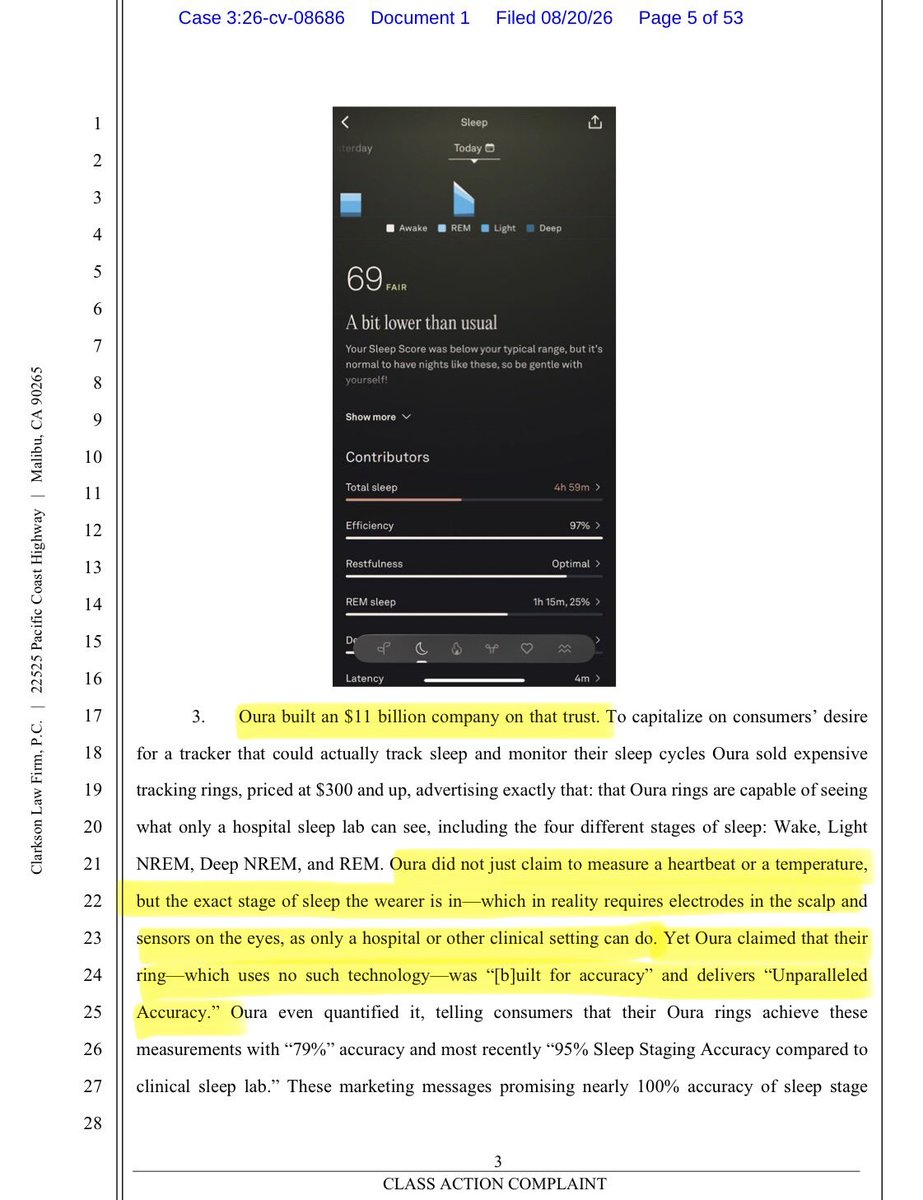
In August 2026, Oura — the world's best-selling sleep-tracking wearable brand — was hit with a federal class action in the U.S. The plaintiffs claim the ring "doesn't accurately measure sleep quality," and that its sleep-stage tracking (deep, REM, light) is misleading.
The complaint's key line is striking: "Sleep happens in the brain, not on one's finger." Oura's AI models are described as "doing guess work" about what is actually happening — and as "taking advantage of desperate consumers who struggle with their sleep."
One plaintiff, Madison Surber, says she paid $513.68 for an Oura Ring 4 Gold in May 2025 after the company marketed 79%–95% clinical accuracy compared with polysomnography (PSG) labs. The suit covers buyers of Ring 4, Ring 4 Ceramic, and Ring 5, seeking damages and an end to the challenged marketing. Oura says it disputes the allegations and will defend the case.

Why wearables can't nail sleep stages
The lawsuit highlights a fundamental physics problem: rings and watches only measure indirect body-surface signals — heart rate, heart-rate variability (HRV), movement, temperature, and breathing. These correlate with sleep stages but do not define them.
True sleep staging is defined by brain activity (EEG), plus eye movement (EOG) and muscle tone (EMG). To capture those, you need a polysomnography lab or an EEG headband. Notably, some Oura competitors — like SleepOn and Circul — deliberately avoid claiming stage-level accuracy, precisely because indirect signals can't deliver it.
Studies of consumer wearables versus hospital PSG generally show stage-by-stage agreement around 60%, far below the 79%–95% figures some marketing promised.
Why this matters beyond Oura
This is the first big warning shot for the entire health-wearable industry: where is the legal line for health claims? "Not a medical device" disclaimers have long been a shield, but when advertising says "precise sleep tracking" and "AI sleep coach," consumers reasonably expect an accurate measuring tool.
If the class action succeeds, Oura users may get compensation — but the bigger effect will be forcing every wearable brand to either back claims with published science or tone down the marketing.
How to read your own sleep score
1. Use trends, not single nights. A 30-day trend is far more meaningful than one night's number; a sudden drop may signal something physical, but it doesn't mean you "slept badly."
2. Know what it measures. Without EEG, a wearable gives you an estimate. If precision matters, consider EEG headbands or an in-lab PSG.
3. Don't let the score own you. Sleep anxiety is itself a cause of insomnia — obsessing over tonight's number makes things worse.
4. Read the claims carefully. Distinguish "activity tracking" from "medical-grade sleep staging"; the latter requires certification and published validation.
FAQ
Q1: How accurate is my smartwatch or ring's sleep data, really?A: Consumer wearables typically agree with lab PSG on sleep stages about 60% of the time, and often misplace deep/REM boundaries; long-term trends in heart rate and temperature are usually reliable.
Q2: If the class action succeeds, what do Oura users get?A: Likely modest cash or discount compensation; the real win is forcing more honest marketing across the industry.
Q3: Are there medically validated sleep trackers?A: Yes — home PSG devices and FDA-cleared EEG headbands, though they tend to be pricier and sometimes prescription-only. Consumer rings and watches are mostly "wellness reference" devices.
Q4: Is Oura's data completely useless?A: No. Trends in HRV, temperature, and resting heart rate are genuinely useful for recovery and readiness. The weak spot is sleep-stage classification, which needs brain signals.
Q5: Should I return my ring because of the lawsuit?A: Not necessarily — unless you bought it solely for precise sleep staging. Understand its limits and treat the score as a reference; if Oura ultimately loses, class members usually get automatic settlement notices.
留言
張貼留言