One-line conclusion: NVIDIA is reportedly spending $5–10 billion to acquire long-haul "dark fiber" networks across the United States, signaling that the AI infrastructure race is shifting from raw compute power to the networks that connect it.
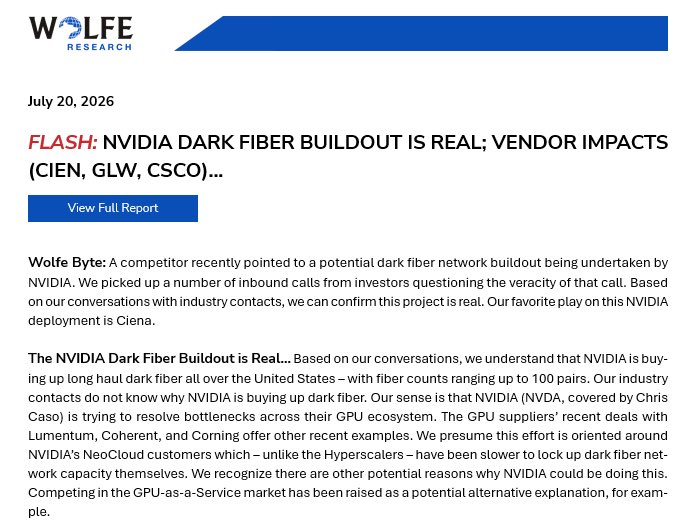
NVIDIA is reportedly acquiring long-haul "dark fiber" networks across the United States, with total capacity estimated at 7.6 Pbps and a price tag between $5 billion and $10 billion. The news sent optical communications stocks surging globally: Taiwan's optical module makers jumped on July 22, and three more hit the daily limit on July 23. Many now read this as the moment the AI arms race moved from "who has more GPUs" to "who owns the network."
What Is Dark Fiber, and Why Buy Instead of Lease?
Dark fiber refers to fiber-optic cable that has already been laid but has no transmission equipment installed and carries no optical signal. The fiber cores sit "dark" and dormant, waiting to be activated — it's a state of fiber infrastructure, not a product from a specific company. Across the United States, vast amounts of long-haul fiber lie unused, owned by telecoms, railroad companies, and energy firms.

Why would NVIDIA pay billions to own rather than lease? Because GPU clusters have unique demands. Training large AI models requires synchronizing data across tens of thousands of GPUs, where latency and bandwidth directly determine training efficiency. Leasing traditional telecom lines means sharing bandwidth with other customers and waiting on the carrier's upgrade schedule. Owning dark fiber lets NVIDIA deploy its own DWDM multiplexers, fiber arrays, and optical connectors — putting the entire "AI highway" under its control.

From GPUs to Fiber: How the AI Infrastructure Race Is Spreading
Industry analysts see three possible motives. First, solving the GPU ecosystem's transport bottleneck: optical components (optical engines, lasers, fiber arrays) have been flagged as the next supply bottleneck for AI hardware. Lumentum recently warned that indium phosphide (InP) laser material production is running more than 30% behind hyperscaler demand, and NVIDIA has already invested roughly $2 billion each into Lumentum and Coherent to lock up wafer capacity — buying fiber and investing in optical suppliers are two pieces of the same blueprint.
Second, targeting the GPU-as-a-Service market: NVIDIA's NeoCloud customers (smaller cloud providers) have been slower than Amazon and Microsoft to secure their own dark fiber capacity. If NVIDIA can offer a one-stop "AI factory" of compute plus dedicated networking, it can charge enterprise customers directly and reduce dependence on hyperscalers.
Third, building a new moat: by owning long-haul fiber, NVIDIA holds both the "brain" (GPUs) and the "nervous system" (network) of AI computing. Anyone wanting to rent AI compute would have to go through NVIDIA's infrastructure, dramatically strengthening its negotiating position.
Who Wins? The Order Pipeline Picture for Optical Suppliers
Analysts have named Ciena (CIEN) as the "favorite play" for this deployment, with Cisco, Nokia, and Corning also expected to benefit from order inflows. Activating dark fiber requires massive quantities of DWDM multiplexers, fiber arrays, optical connectors, and patch panels — exactly the strengths of optical component makers. Taiwan-based suppliers such as Grand Ocean, LuxNet (華星光), Bravo Tech, LandMark Optoelectronics (聯亞), and Lian Jun are all seen as potential beneficiaries.

One caveat: the dark fiber acquisition is still a market rumor, not officially confirmed by NVIDIA, and most supplier orders remain at the "imagination" stage. History shows optical stocks rally hard on headlines but can correct just as violently if order numbers fail to materialize. Instead of chasing momentum, investors should track three verification signals: whether NVIDIA confirms the deal, order visibility at equipment makers like Ciena, and whether Taiwan suppliers' revenue actually grows.
Conclusion
NVIDIA's move from selling chips to buying fiber isn't a departure from its core business — it's the natural extension of AI infrastructure logic: compute is only valuable if the network is fast enough to connect it. As the AI race evolves from "who has more GPUs" to "who has the fastest network," fiber — a seemingly old-fashioned technology — is becoming the most underestimated strategic resource of the AI era.
FAQ
What's the difference between dark fiber and regular fiber?Dark fiber is laid but unlit — no transmission equipment installed and no signal carried, waiting to be leased or bought and activated. Regular fiber already has carrier equipment installed and provides service. Dark fiber's appeal is that the buyer controls equipment choices and bandwidth provisioning entirely.
Is NVIDIA's move good or bad for telecom carriers?Short term it's a threat — NVIDIA bypasses carriers by building its own network. Long term it could be an opportunity: carriers hold enormous dark fiber assets that NVIDIA wants to buy, letting them monetize idle infrastructure and become "fiber landlords."
Will a $10 billion acquisition hurt NVIDIA's financials?NVIDIA's annual revenue is in the hundreds of billions, so $10 billion is an affordable capital expenditure, though it adds depreciation and maintenance costs. The market cares more about whether it converts into a new GPU-as-a-Service revenue stream.
What does 7.6 Pbps actually mean?Pbps (petabits per second) measures bandwidth. 7.6 Pbps is equivalent to transmitting millions of HD videos simultaneously — enough to support interconnection between dozens of large AI data center clusters.
Can the optical stock rally last?It depends on how fast orders materialize. Right now it's mostly headline-driven. If NVIDIA confirms the deal and starts ordering from Ciena and Taiwan suppliers, supply chain revenue will genuinely benefit. If the rumor fades, high-flying stocks face real correction risk — fundamentals should be the guide.
留言
張貼留言