One-line conclusion: Moonshot AI's Kimi K3 ranks #2 globally on LMArena's blind human evaluation with 2.8 trillion parameters and full open-source release, but its hallucination rate is 8-12% higher than GPT-5.6 and its pricing, while half of OpenAI's, is the most expensive among Chinese models. The real test isn't benchmark scores — it's ecosystem building.
The AI Landscape Shifted Overnight
On July 17, 2026, a Chinese AI company you might not have heard of — Moonshot AI — shook the entire AI industry with a single announcement.
Its flagship model Kimi K3 would be fully open-sourced on July 27.
This wasn't just another model launch. K3 has 2.8 trillion parameters and ranks #2 globally on the LMArena (Chatbot Arena) blind human evaluation leaderboard — ahead of Anthropic's Claude Opus 4.8 and trailing only OpenAI's GPT-5.6.
And it's open source.
This means any individual, company, or research institution can download the full model weights for self-deployment, fine-tuning, distillation, and commercialization.
 LMArena Frontend Code rankings: Kimi K3 tops the chart at 1679 points, surpassing Claude Fable 5, ranking #1 in 6 of 7 domains
[//]: # (Image of Kimi K3 LMArena ranking from @arena Twitter post)
What Makes K3 Special?
1. Architecture Innovation
K3 uses Moonshot AI's self-developed MoE (Mixture of Experts) architecture with sparse activation — each inference only activates a fraction of the total parameters. This means K3's inference cost is far lower than a dense model of equivalent total size.
Key innovations include hierarchical attention mechanisms, adaptive routing, and dynamic expert allocation during training. Moonshot AI's technical report claims K3's training efficiency is approximately 40% higher than comparable dense models.
2. Native Multimodal Capabilities
K3 doesn't just process text — it natively understands video, audio, and images. This isn't "extract frames from video then analyze" — the model directly understands tone shifts, sound effects, and scene transitions.
In practice, this means you can feed a YouTube video directly to K3 and have it analyze the speaker's emotional tone and pacing without first converting to a transcript.
3. The Open Source Gambit
This is arguably the most disruptive aspect.
Before K3, no Chinese flagship model had ever been fully open-sourced. Baidu's ERNIE, Alibaba's Qwen, Tencent's Hunyuan — these models have APIs but their weights were never released. K3's open-source decision effectively gives away China's most powerful AI model to the world.
Pricing: Half of GPT-5.6, But Most Expensive Among Chinese Models
Moonshot AI's pricing for K3:
- Input: $3.00 per 1M tokens
- Output: $15.00 per 1M tokens
- Cached input: $0.30 per 1M tokens (90% discount)
Compared to GPT-5.6 ($3/$15 per 1M tokens) — roughly half the price on a cost-per-task basis. Compared to Claude Opus 4.8 ($24/1M output tokens), K3 is ~66% cheaper.
But among Chinese models, K3 is the most expensive — DeepSeek V4 Pro costs just $0.04 per 1M output tokens, and GLM-5.2 costs $0.32.
Controversies and Concerns
Hallucination Rate
On standard benchmarks (MMLU, HumanEval), K3's performance is genuinely impressive. But on hallucination tests, K3 underperforms GPT-5.6 and Claude Opus 4.8 by a notable margin — roughly 8-12% higher hallucination rate in fact-verification tasks.
 DRAM price forecast: QoQ increase of 21% for Q3, HBM demand remains strong — AI hardware demand underneath the bubble narrative
This is a deal-breaker for certain applications: legal analysis, medical diagnosis, and financial calculations demand precision that K3 can't yet guarantee.
Privacy and Compliance
Open source brings flexibility but also responsibility. K3's training data contains large amounts of Chinese web content, raising two issues:
1. Data compliance: Does the training data include copyrighted material?
2. Content filtering: Will the open-source version lack the safety layers of the API version?
Moonshot AI has stated the open-source version will not include safety filters — developers manage their own.
Market Impact
Short-term: Hardware stocks sell off
K3 proved a top-tier model can be built on a fraction of the budget, challenging the "AI arms race = infinite NVIDIA demand" narrative. Semiconductor stocks sold off sharply after July 17 — NVIDIA, AMD, and Micron all dropped.
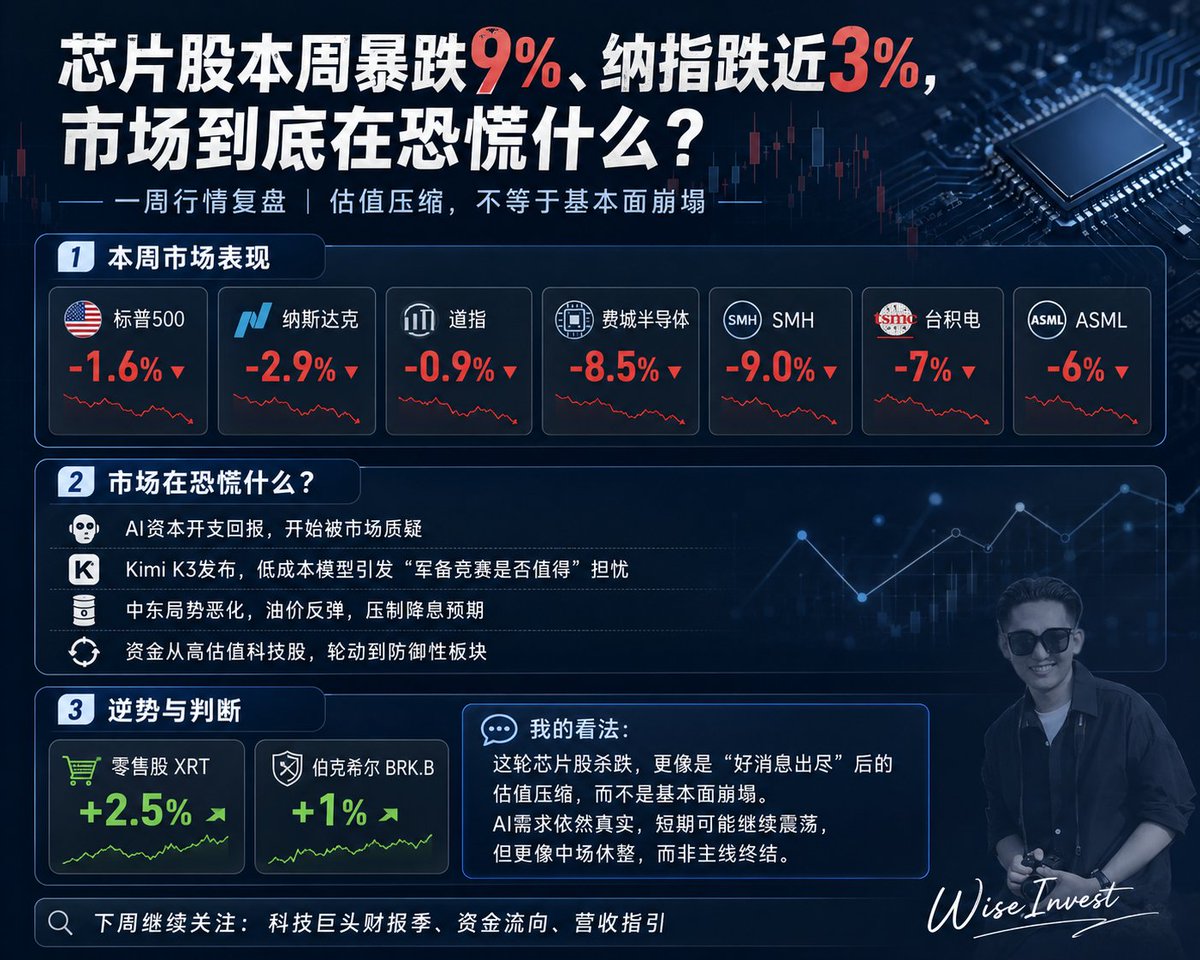 The K3 selloff pattern: short-term pain, long-term gain — same script as DeepSeek
Long-term: Jevons Paradox kicks in
DeepSeek's precedent tells us model efficiency gains never reduce total compute demand — they explode it by lowering adoption barriers. K3's open-source release will enable more SMBs to enter the AI application space, ultimately driving more inference demand and hardware growth.
What This Means for Developers
For developers in Taiwan, Hong Kong, and globally, K3's open-source release offers:
1. Self-hosting: Replace GPT-5.6 for daily development tasks at 50-66% cost reduction
2. Model distillation: Distill smaller specialized models for customer service, translation, or data analysis
3. Hybrid strategy: Use self-hosted K3 for daily tasks, GPT-5.6 for high-precision scenarios
Conclusion: Ecosystem Is the Real Battlefield
K3's benchmarks are genuinely impressive — 2.8T parameters, #2 globally, open source. These are milestones worth celebrating.
But the real test is ecosystem building.
OpenAI has Plugins, the Assistants API, and the GPT Store. Anthropic has Claude for Work and enterprise-grade compliance. Google has Vertex AI and its full cloud ecosystem. These are moats that parameter count alone cannot breach.
K3's open-source release is step one. Developer tools, documentation quality, community support, and enterprise services will determine how far it can go.
FAQ
Q1: Is Kimi K3 really better than ChatGPT?A1: On LMArena blind evaluations, K3 ranks #2 (behind GPT-5.6), ahead of Claude Opus 4.8. But benchmarks aren't everything — K3 has a higher hallucination rate and a much weaker ecosystem.
Q2: What does open-source K3 mean?A2: Anyone can download the full model weights for self-deployment, fine-tuning, and commercial use. This is the first time a top-tier Chinese model has been fully open-sourced.
Q3: Is K3 actually cheaper than GPT-5.6?A3: On a cost-per-task basis, K3 is about half the price of GPT-5.6 and one-third of Claude Opus 4.8. But it's the most expensive Chinese model (2x DeepSeek V4 Pro).
Q4: What are K3's weaknesses?A4: Higher hallucination rate (8-12% worse on fact-verification), unclear training data compliance, and lack of safety filters in the open-source version.
Q5: Should I use K3 or GPT-5.6?A5: For daily tasks, creative writing, and coding — K3 is sufficient and cheaper. For precision fact-checking, legal analysis, and medical advice — GPT-5.6 is more reliable.
Q6: Will K3 reduce NVIDIA's GPU demand?A6: Short-term market sentiment may be negative, but long-term Jevons Paradox applies — cheaper models drive more applications, which increases total compute demand.
Q7: How can developers benefit from K3?A7: Direct self-hosting for cost reduction, distillation for specialized use cases, and hybrid deployment strategies combining K3 with GPT-5.6 for high-precision tasks.
Tags: #KimiK3 #AI #OpenSource #MoonshotAI #LLM #Benchmarks #ChineseAI
留言
張貼留言