跳到主要內容

Claude Opus 5登頂AI智能排行榜!它真的比GPT-5.6和Fable 5強嗎?

一句話結論: Claude Opus 5以61分智能力指數登上Artificial Analysis排行榜第一,超越GPT-5.6 Sol的59分和Claude Fable 5的60分,但真正的價值不在榜首位置,而在以更低成本提供接近前沿的智能。

2026年7月24日,Anthropic正式發布Claude Opus 5。這款被稱為「深思熟慮且主動」的模型,在Artificial Analysis Intelligence Index上以61分奪冠,超越自家兄弟Fable 5(60分)和GPT-5.6 Sol(59分)。更令人矚目的是,它的每任務成本僅$2.03,比Fable 5的$2.75低26%。

Claude Opus 5官方發布公告

從benchmark數據來看,Claude Opus 5的強項在代理式知識工作。在GDPval-AA v2基準上,Opus 5(max)獲得1861 Elo分數,比Fable 5和GPT-5.6 Sol高出100分以上。在AA-Briefcase(專業知識工作基準)上,它以1720 Elo領先Fable 5達146分。這些測試衡量的是模型產生準確且專業呈現的輸出的能力。
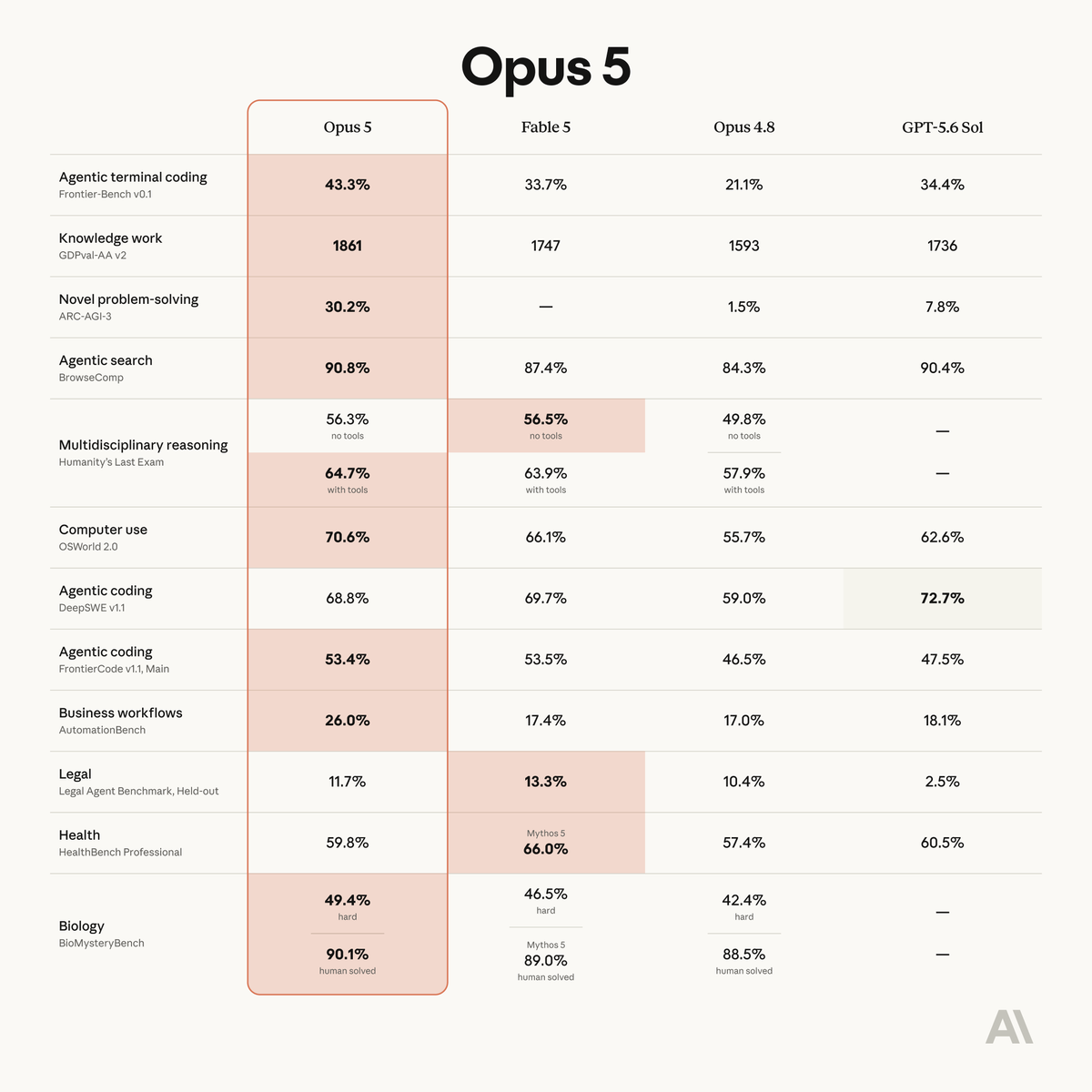
Claude Opus 5 benchmark數據

然而,「最聰明」不等於「最適合所有任務」。2026年AI圈最實用的認知是按任務路由——不同模型在不同領域各有優勢。

前端設計與UI開發方面,Kimi K3在Frontend Code Arena以9.5分輕鬆勝過Fable 5的7.5分和Sol的7分,成本僅為Fable的1/12。後端與複雜系統架構方面,Fable 5以SWE-Bench Pro 80.3%的成績領先,適合長時間自主代理工作。調試任務則適合GPT-5.6 Sol的迭代假設驅動模式。

Artificial Analysis Intelligence Index排行榜

Claude Opus 5的策略很明確:不是取代Fable 5,而是提供一個「接近前沿智能但成本減半」的選項。Anthropic的定價策略暗示了兩層定位——Fable 5面向需要最高推理強度的複雜代理任務,Opus 5則適合日常知識工作與專業輸出場景。

值得注意的是,黃仁勳(Jensen Huang)近期首次公開發文討論開放模型的重要性,認為開放權重將推動AI生態多樣化。Kimi K3將於7月27日開源完整權重,加上DeepSeek V4 Pro(MIT許可,SWE-Bench Verified 80.6%)和GLM-5.2(1M上下文),開源陣營正在快速追趕。

真正的問題不是「誰是第一」,而是「哪個模型最適合你的任務」。2026年的核心技能是路由,而非品牌忠誠度。

常見問題 (FAQ)

Q: Claude Opus 5真的比GPT-5.6強嗎?

A: 在智能力指數上Opus 5以61分領先GPT-5.6 Sol的59分,但在特定任務(如調試)上GPT-5.6仍有優勢。沒有「最強模型」,只有最適合任務的模型。

Q: Claude Opus 5和Fable 5有什麼不同?

A: Opus 5定位為「接近前沿智能但成本減半」,適合日常知識工作;Fable 5是頂尖推理模型,適合長時間自主代理任務,但成本更高。

Q: 我應該用哪個AI模型?

A: 取決於任務類型:前端開發用Kimi K3,複雜後端用Fable 5,調試用GPT-5.6 Sol,日常知識工作用Opus 5。

Q: Claude Opus 5的價格如何?

A: 每智能力指數任務平均成本$2.03,比Fable 5的$2.75低26%,比Opus 4.8的$1.80略高。

Q: 開源模型能追上Claude Opus 5嗎?

A: Kimi K3將於7月27日開源,DeepSeek V4 Pro在SWE-Bench Verified已達80.6%。開源陣營正在快速追趕,但頂級閉源模型仍領先。

#ClaudeOpus5 #AI排行榜 #GPT56 #KimiK3 #人工智慧

留言

這個網誌中的熱門文章

Intel 14A Defect Density Is Its Best Since 22nm — Is Intel Back in the Leading-Edge Race?

One-sentence takeaway: Intel's 14A process is cutting defect density faster than any node since 22nm, and customers have moved from watching to asking about capacity — if risk production stays on track for H2 2027, it's the strongest signal yet that Intel is back in the leading-edge game. "We have not seen this performance since 22nm." When Intel CFO David Zinsner dropped that line at the Deutsche Bank 2026 technology conference, the semiconductor world took notice. 14A — Intel's first 1.4nm-class node — is backing up the company's comeback story with data, not slogans. What is 14A, and why it matters 14A is Intel's most advanced planned process node, a "1.4nm-class" technology targeting high-volume manufacturing in 2028. It packs three headline technologies: second-generation RibbonFET gate-all-around transistors, PowerDirect backside power delivery, and High-NA EUV lithography. In short, it's the most technically complex node Intel ...

Google's Antitrust Remedies Enter Deep Water: Breakup, AI Mode, and the Browser

Bottom line: The U.S. DOJ's remedies phase against Google is redefining the commercial rules of "search" — from Chrome's fate to AI distribution and the ad business, every step could reshape global tech. Google's search monopoly case has been called "the most important antitrust case of the internet era." In August 2024, a federal judge ruled Google violated antitrust law; now the remedies phase is in deep water. The DOJ's proposals include breaking up the ad business, divesting Chrome, and ending default search agreements — each step ripples through the entire tech industry. Timeline: from monopoly ruling to remedies In August 2024, the D.C. federal court ruled that Google violated the Sherman Act by paying billions annually to make Apple, Samsung, and others set Google as the default search engine. The remedies trial runs through 2026, with DOJ options including: Breaking up the ad business: Google's ad tech stack is accused of stifl...

Why Is NVIDIA Spending Billions to Buy Up America's "Dark Fiber"?

One-line conclusion: NVIDIA is reportedly spending $5–10 billion to acquire long-haul "dark fiber" networks across the United States, signaling that the AI infrastructure race is shifting from raw compute power to the networks that connect it. NVIDIA is reportedly acquiring long-haul "dark fiber" networks across the United States, with total capacity estimated at 7.6 Pbps and a price tag between $5 billion and $10 billion. The news sent optical communications stocks surging globally: Taiwan's optical module makers jumped on July 22, and three more hit the daily limit on July 23. Many now read this as the moment the AI arms race moved from "who has more GPUs" to "who owns the network." What Is Dark Fiber, and Why Buy Instead of Lease? Dark fiber refers to fiber-optic cable that has already been laid but has no transmission equipment installed and carries no optical signal . The fiber cores sit "dark" and dormant, waiting to...