One-line conclusion: SpaceX is restructuring its supply chain under an "NCNT" (No China, No Taiwan) standard — barring Chinese nationals and Chinese-made equipment from supplier facilities and pushing for more overseas production — while over $100 billion in stock becomes tradable in August, putting the space industry at the intersection of geopolitics and capital markets.

Nikkei Asia reported exclusively on July 30 that Elon Musk's SpaceX is taking aggressive steps to ensure China has no influence over its operations or supply chain. SpaceX has sent audit teams to review existing and prospective suppliers, instructing partners across its global supply chain not to assign or employ Chinese nationals at facilities producing SpaceX products, and not to use systems or equipment made by Chinese companies. The goal: fully insulate production of technologies critical to U.S. national security from Chinese influence.
What Is "NCNT," and Why Does It Exclude Taiwan Too?
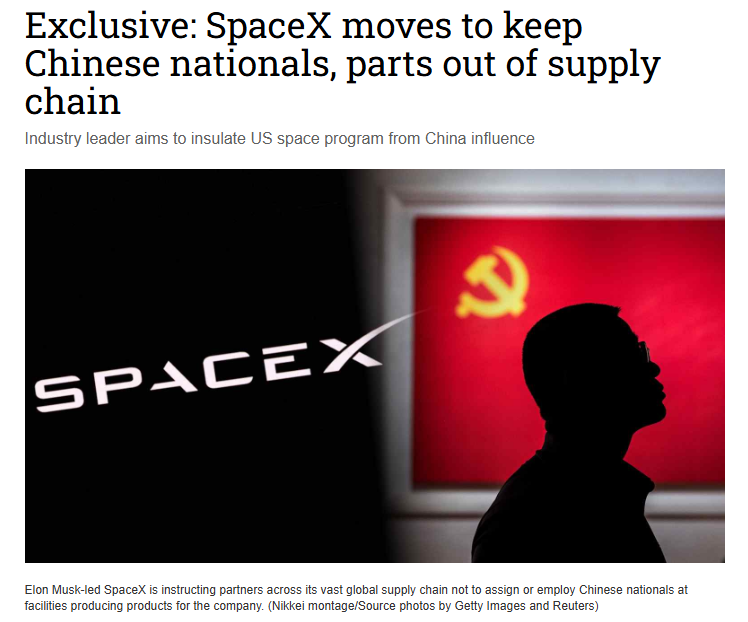
What's striking is that SpaceX's decoupling isn't limited to China. According to Taiwan's Commercial Times and Central News Agency, SpaceX is building what it calls an NCNT (Non-China, Non-Taiwan) supply chain, designed to reduce the risk of supply disruption if tensions escalate in the Taiwan Strait. Senior executives at Taiwanese supplier companies confirmed SpaceX is indeed asking for a higher share of overseas production; some have already expanded lines in Southeast Asia, though the transition takes time.
Why exclude Taiwan as well? The reason is straightforward: SpaceX is a major U.S. defense contractor (recently winning a $1.6 billion military contract), and its satellite and rocket technology touches national security. Taiwan is a hub of the global electronics supply chain, but geopolitical risk is a variable SpaceX can't ignore — spreading critical component production across Southeast Asia and Europe is effectively buying "political insurance" for the supply chain. Central News Agency named Taiwanese low-earth-orbit satellite suppliers including Universal Microwave, Wistron NeWeb, Unimicron, Win Semiconductors, and TXC as facing near-term capital expenditure pressure from capacity relocation.
The $100 Billion Unlock: August 6 Is the Moment

While the supply chain restructures, SpaceX's capital markets story is reaching a historic inflection point. SpaceX listed in June 2026 (ticker: SPCX), with only about 4.85% of shares entering public trading at the IPO. All eyes are on the first early-release window on August 6: the free float jumps from roughly 4.9% today to about 11.8%, with more tranches unlocking afterward — in total, over $100 billion worth of stock becomes eligible to trade.
Google's stake makes the market hold its breath. Google recently disclosed it owns $94.1 billion in SpaceX stock (roughly a 6% stake), of which $80 billion is in short-term restricted shares. When restrictions lift, those holdings could theoretically be sold, and selling pressure worries persist. The data shows that even SpaceX's announcement of a $1.6 billion military contract on July 30 couldn't lift the stock — it fell 3.32% to close near $112, as traders fixed their gaze on the August 6 unlock.

But some market participants push back: SpaceX employees and long-term investors have strong conviction in the company, and many will choose to hold rather than sell. Recent deals with Google and Anthropic, plus results from Cursor, underpin solid revenue momentum. Whether the unlock turns into a "selling flood" or "thunder without rain" will be decided in the first week of August.
How Geopolitics Is Reshaping the Space Industry
SpaceX's NCNT supply chain isn't an isolated case — it's the "China Plus One" strategy applied to the space sector. From semiconductors and EVs to rockets, global supply chains are being re-drawn with "geopolitical security" as the highest principle. For investors, that means two watch lines. First, the winners of supply-chain relocation — Southeast Asian capacity and non-China component suppliers stand to benefit. Second, near-term volatility in SpaceX stock — the tug-of-war between unlock selling pressure and fundamentals offers a rare observation window.
Worth noting: Musk's Tesla appears to be making similar adjustments. Reports suggest Tesla is preparing to split off its China business, partly to avoid sensitive conflicts of interest if it eventually merges with SpaceX, a major defense contractor. If that happens, Tesla's China supply chain and overseas supply chain would run on "two tracks" — yet another major shift in global manufacturing.
Conclusion
Musk's rockets aren't just flying to space — they're reshaping a supply chain that routes around geopolitical risk. When SpaceX is simultaneously a U.S. defense contractor and the world's most valuable space company, every supply chain decision carries geopolitical weight. NCNT isn't hostility toward any single market; it's a self-protection strategy for turbulent times — it's just that the bill for this insurance gets paid by the entire supply chain.
FAQ
What does NCNT mean?NCNT stands for Non-China, Non-Taiwan. It refers to SpaceX's requirement that its supply chain exclude Chinese and Taiwanese capacity and components to reduce the risk of disruption if Taiwan Strait tensions escalate.
Why did SpaceX stay private for so long?SpaceX traded in private markets for years because Musk wanted to maintain control and focus on long-term goals. It only listed in June 2026 (ticker SPCX), releasing just ~4.85% of shares — the vast majority remains held by insiders and early investors.
Is "decoupling" bad or good for suppliers?Short term it's a headwind for existing suppliers asked to relocate capacity (some Taiwanese firms face extra capex). It's a tailwind for suppliers that can offer non-China, non-Taiwan capacity, such as Southeast Asian bases and Western vendors. Overall, restructuring creates a new order distribution.
How can ordinary investors participate in SpaceX?SpaceX listed on the exchange in June 2026 under ticker SPCX, so retail investors can buy shares through a brokerage account. The August 6 unlock may bring volatility — which can also be an opportunity to assess long-term fundamentals.
Will Google's $94.1 billion stake trigger a sell-off?About $80 billion of Google's stake is in short-term restricted shares, which become sellable after unlocking. But Google has historically held strategic investments long-term (its early SpaceX investment came with satellite service partnerships), so a rapid large-scale dump is unlikely. The more likely selling pressure comes from employee shares and early venture funds.
留言
張貼留言