One-sentence takeaway: After compute, AI's next bottleneck is data transmission. Silicon photonics is expected to go mainstream within 1–2 years, but its laser light sources depend on indium phosphide (InP) — a highly concentrated, slow-to-expand material. Behind the optical networking rally lies a strategic land grab at the materials layer.
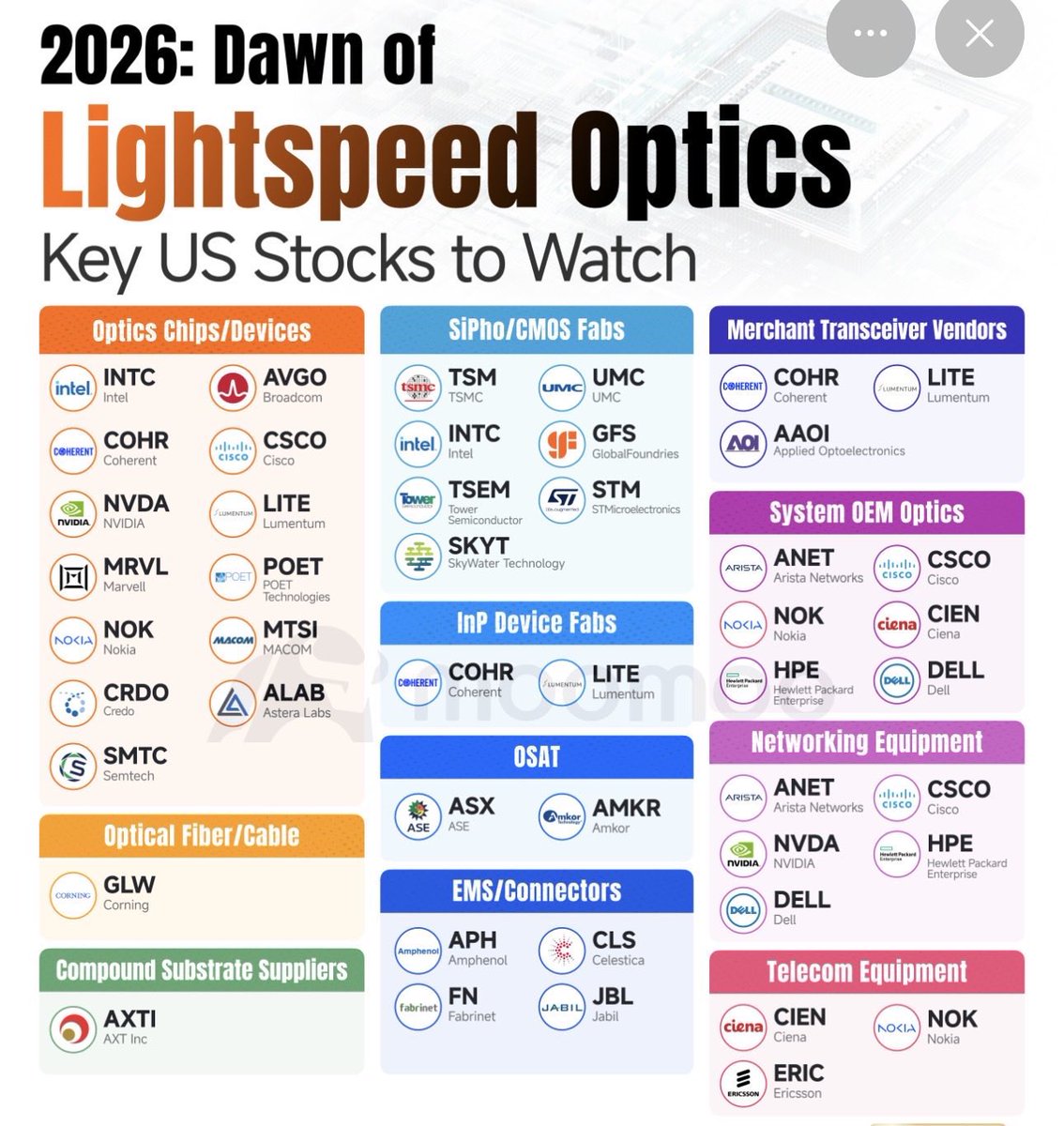
Ten Limit-Up Stocks Later, "InP" Is Trending
In late August 2026, Taiwan's optical communications stocks staged a limit-up frenzy, pushing "indium phosphide" onto Google Trends. Two catalysts: silicon photonics sentiment went into overdrive, and compound-semiconductor leader WIN Semiconductors publicly stated that silicon photonics products could become mainstream within 1–2 years — and that it is "not worried about InP material shortages."
One statement soothed both sides of the market: demand is real, and supply is manageable. But what exactly is InP, and why does the whole industry treat it as strategic?
InP: The Light Source of the AI Data Center
Indium phosphide is a III-V compound semiconductor whose superpower is efficiently generating and detecting light. Silicon excels at logic but cannot emit lasers directly; meanwhile, the massive data traffic between GPUs in AI clusters is shifting from copper to fiber — and every optical link needs a laser chip made from InP.
Here's the crux: silicon photonics modulates and routes light, but it cannot generate the light itself. As industry observers put it: "Silicon photonics can modulate light, but it cannot generate the light source." With 800G and 1.6T transceivers ramping and co-packaged optics (CPO) pushing engines inside the switch, demand for InP lasers is set to scale exponentially.

Mapping the Supply Chain Battleground
From analyst-drawn industry maps, the silicon photonics chain has four layers:
- Optical chip designers: Broadcom, Coherent, Lumentum, Marvell, NVIDIA control core components;
- SiPho foundries: TSMC, UMC, Intel, GlobalFoundries fabricate silicon-photonic wafers;
- InP device fabs: Coherent and Lumentum dominate laser production as a duopoly;
- Upstream materials: AXT, Sumitomo supply InP substrates — the scarcest link.
WIN Semiconductors deserves special attention. It built a ~60% global share in GaAs RF foundry services and is now extending decades of compound-semiconductor manufacturing expertise into optical networking. Its confidence about avoiding shortages rests on deep III-V engineering — which is precisely why the market believed it.

After the Limit-Up Frenzy: Three Reality Checks
Is the shortage real or just a narrative? AXT's long-term supply deal with Lumentum and Coherent calling InP capacity its "primary constraint" confirm genuine bottlenecks. But capacity expansion takes 2–3 years; current stock prices reflect expectations, not earnings. Technology routes are still evolving. Thin-film lithium niobate modulators and other alternatives are advancing, and CPO adoption could lag forecasts. Today's limit-up winners may not all be on the scoreboard three years from now. Valuations have run ahead. Optical names trade at historically high multiples after this year's surge. Before chasing, ask: if CPO volume slips by a year, can these companies justify today's prices?FAQ
Q1: How does InP differ from silicon, and why is it irreplaceable in optical links?A: Silicon is an indirect-bandgap material that cannot emit light efficiently; InP is direct-bandgap and excels at generating lasers and detecting photons. Every optical interconnect needs a light source, so pure-silicon solutions can't replace InP lasers.
Q2: What is silicon photonics, and how does it relate to existing chipmaking?A: Silicon photonics builds optical components (waveguides, modulators, detectors) on CMOS-compatible silicon wafers using mature fab processes. It turns optics from expensive craftsmanship into scalable chip manufacturing — key to cost-efficient AI data centers.
Q3: WIN says there's no shortage concern — credible?A: WIN has spent decades in GaAs/InP compound-semiconductor foundry with real materials-engineering capability, and it's expanding optical capacity. Still, chain-wide relief depends on upstream substrate expansion; tightness over the next 1–2 years remains likely.
Q4: How can ordinary investors participate?A: Beyond individual stocks, look at optical networking or semiconductor equipment ETFs. Distinguish companies with actual InP/silicon-photonics revenue from pure story plays, and watch valuations and CPO timelines.
Q5: If InP stays short, what are the alternatives?A: Near-term substitutes are limited because the physics of light generation can't be bypassed. Longer term, watch higher-efficiency VCSEL approaches, TFLN modulators paired with existing sources, and the industry's transition to 6-inch InP wafers.
留言
張貼留言