NVIDIA Announces CPO Optical Interconnect Is in Mass Production, AI Server Shipments Could Grow 31% in 2026 — Is Bandwidth the Next Battleground?
One-sentence takeaway: The AI race is shifting from "compute arms race" to "bandwidth arms race" — NVIDIA's announcement that co-packaged optics (CPO) has entered mass production, combined with AI server shipment growth forecast near 31%, signals the silicon photonics era has officially begun, with optical supply chains as the next major beneficiaries.
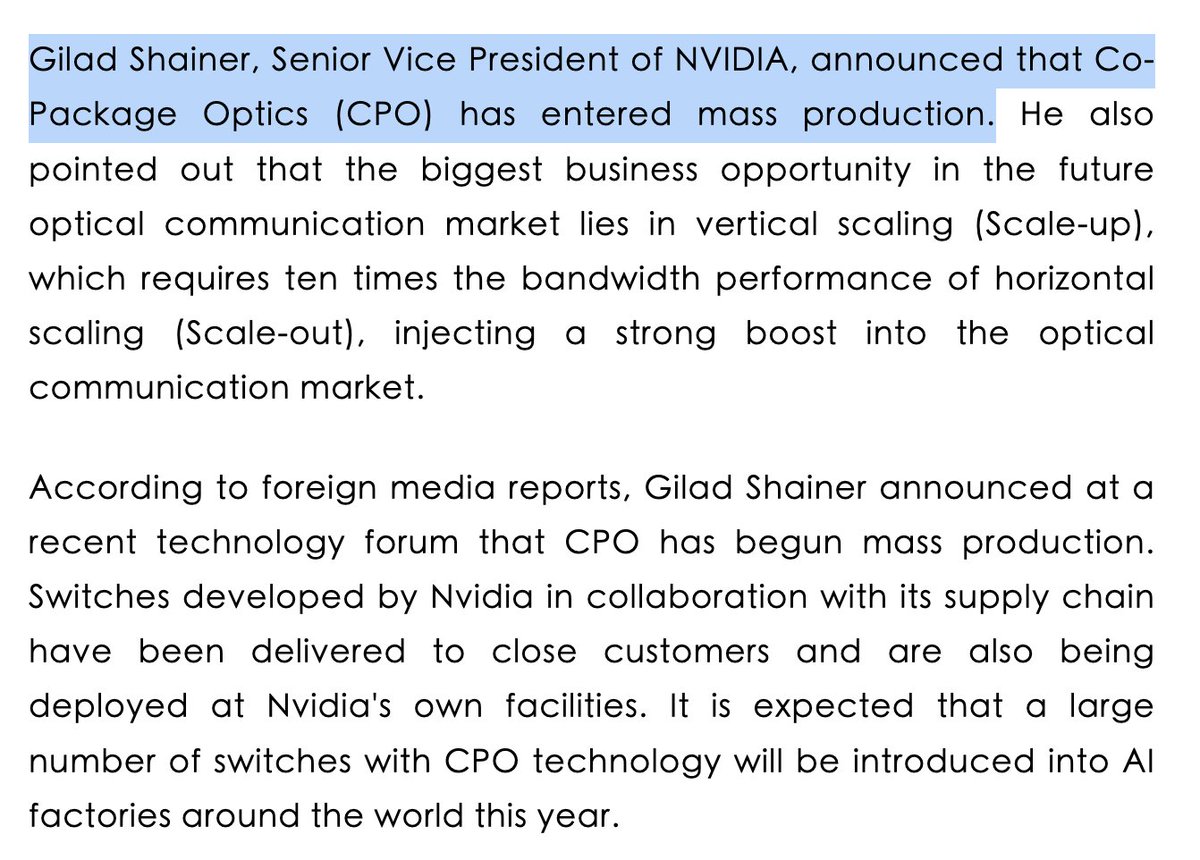
NVIDIA's stock recently closed at $206.64 (up 2.93% in a day), pushing its market cap past $5 trillion. But what really electrified the market wasn't earnings — it was two pieces of news: co-packaged optics (CPO) is now in mass production, and AI server shipments are projected to grow nearly 31% year-over-year in 2026. Optical communication stocks surged immediately, with many hitting daily price limits. Why did "light" suddenly become the star of the AI world?
What is CPO, and why does the AI data center need it?
CPO (Co-Packaged Optics) places optical components directly next to the switch ASIC, letting data travel between chips as light. Traditionally, servers were connected via pluggable optical modules, but AI training demands extremely high bandwidth and low latency between GPUs — copper cables lose bandwidth rapidly over distance, while discrete optical modules are hitting power and density limits.
The significance of CPO: it brings light right next to the chip, dramatically shortening signal paths while cutting power consumption and latency. Broadcom's Tomahawk 5 switch has already shipped over 50,000 units, and the next-generation Tomahawk 6 delivers 102.4 Tbps per chip — the technology has moved from demonstration to commercial deployment. NVIDIA SVP Gilad Shainer confirmed at a technology forum that CPO switches developed with its supply chain have been delivered to core customers and deployed in NVIDIA's own data centers, with large numbers of CPO switches entering AI factories worldwide this year.
AI server shipments up ~31% in 2026 — where does the money come from?
TrendForce raised its 2026 AI server shipment growth forecast from 28% to nearly 31%, driven by capital expenditure from the nine largest cloud service providers (CSPs) — projected to grow about 90% year-over-year, exceeding $886.7 billion. In other words, cloud giants are pouring money into AI infrastructure at double the pace, and that money ultimately flows to servers, switches, cooling, and optical supply chains.
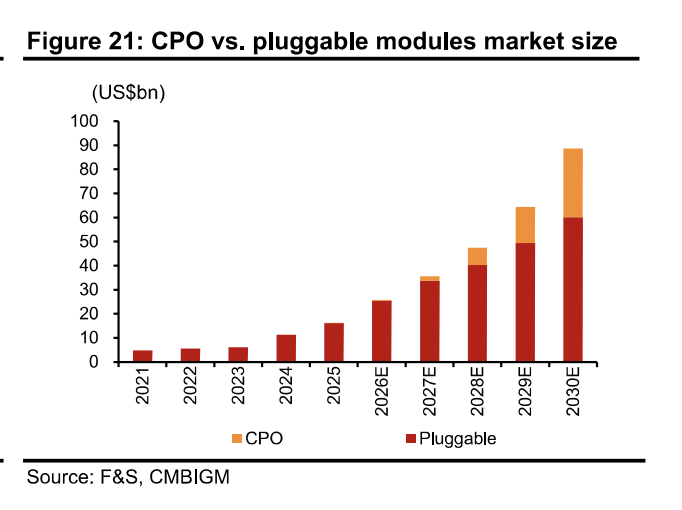
Importantly, CPO is not an immediate replacement for pluggable optical modules. The analyst consensus: pluggables remain the near-term volume engine, while CPO grows at a faster pace, jointly addressing AI networking's triple constraints of power, density, and copper-reach limits. The two are complementary, not mutually exclusive.
Who are the first movers?
According to people familiar with NVIDIA's plans, CoreWeave, Lambda, and Oracle Cloud Infrastructure (OCI) are the first adopters of NVIDIA Photonics with CPO for scale-out networks. All three are flagship AI cloud computing customers — their adoption signals CPO has moved from "lab technology" into real production environments.

The hidden supply chain gap: indium phosphide
The other side of optical mass production is critical material scarcity. Lumentum notes the supply gap for indium phosphide (InP) — the core material for lasers and photodetectors — has widened to 30%. InP capacity expansion takes years, and cannot be accelerated overnight. This means: even if end demand explodes, material supply could become the bottleneck, giving upstream material players significant pricing power.
What should investors watch?
On valuation, NVIDIA trades around 31.7x trailing earnings — not extreme for a growth stock, but it shows much optimism is already priced in. Key leading indicators to track: the Vera Rubin platform ramp schedule, actual CPO switch penetration in AI factories, and changes in the InP material supply-demand gap. Mass production is just the starting line; the real test is whether volumes can match the hype.
FAQ
Q1: What's the difference between CPO and traditional optical modules? Why is it key for AI data centers?Traditional designs plug optical modules into the switch faceplate, requiring long signal paths; CPO packages optics directly next to the switch ASIC — shorter paths, lower power, higher density, meeting AI training's extreme bandwidth and latency demands.
Q2: NVIDIA announced CPO mass production — which companies benefit directly?Optical component and module makers, upstream material suppliers (especially indium phosphide), and the switch supply chain all benefit. But note: some gains already reflect expectations — investors should distinguish "real beneficiaries" from "thematic hype."
Q3: Why does Lumentum say the indium phosphide gap has reached 30%?InP is the core material for high-speed lasers and photodetectors, with multi-year expansion cycles. CPO mass production and high-speed module demand are exploding simultaneously, so supply can't keep up short-term, widening the gap to ~30% and potentially bottlenecking optical shipments.
Q4: Will CPO replace traditional optical modules?Not in the near term. Pluggables remain the volume engine; CPO is the faster-growing extension addressing different interconnect layers. Analysts project CPO revenue CAGR of 219% over 2025–2030, while pluggables maintain steady ~30% growth.
Q5: Is the 31% AI server shipment growth forecast reliable?It's TrendForce's forecast based on nine CSPs' capex (up ~90% to $886.7B). Capex is a strong signal of intent, but actual shipments depend on supply chain capacity, chip availability, and end-demand realization — treat it as a directional trend, not an exact guarantee.
留言
張貼留言