One-sentence takeaway: Japan's 10-year government bond yield has surged above 2.95% — closing in on the 3% milestone — while 30- and 40-year yields hit all-time highs. The ultra-cheap funding that Japan has exported to global markets for decades is being withdrawn, and this structural shift will reshape mortgages, equity valuations, and capital flows worldwide.

Why Is "Bonds" Trending Worldwide?
In late August 2026, "bonds" topped Google Trends in multiple regions simultaneously, as Japanese- and Chinese-language news went viral over a string of numbers: Japan's 10-year Japanese Government Bond (JGB) yield broke above 2.95% for the first time since the early 1990s, within touching distance of 3%. The 30-year yield briefly hit 4.03%, and the 40-year climbed past 4.22% — both record highs.
For a market conditioned to treat "Japan = zero rates" as a law of nature, these figures feel surreal. The global carry trade — borrowing cheap yen to buy foreign assets — was built on that foundation. Now the foundation is shifting.
Three Forces Driving the Surge
Fiscal stress. Japan's Finance Ministry requested a record ¥36.6 trillion for debt servicing in its FY2027 budget draft, up 17.1% year-on-year. Markets are asking an uncomfortable question: when interest payments consume roughly a third of the budget, how long can loose fiscal policy last? Tellingly, the ministry itself raised its assumed long-term interest rate for budget planning from 3.0% to 3.8% — official Tokyo is already preparing for a high-rate world. Policy normalization. Investors widely expect the Bank of Japan to hike again as soon as September. With inflation persistently above target, the BOJ keeps shrinking bond purchases, handing long-term pricing power back to the open market — and yields keep climbing.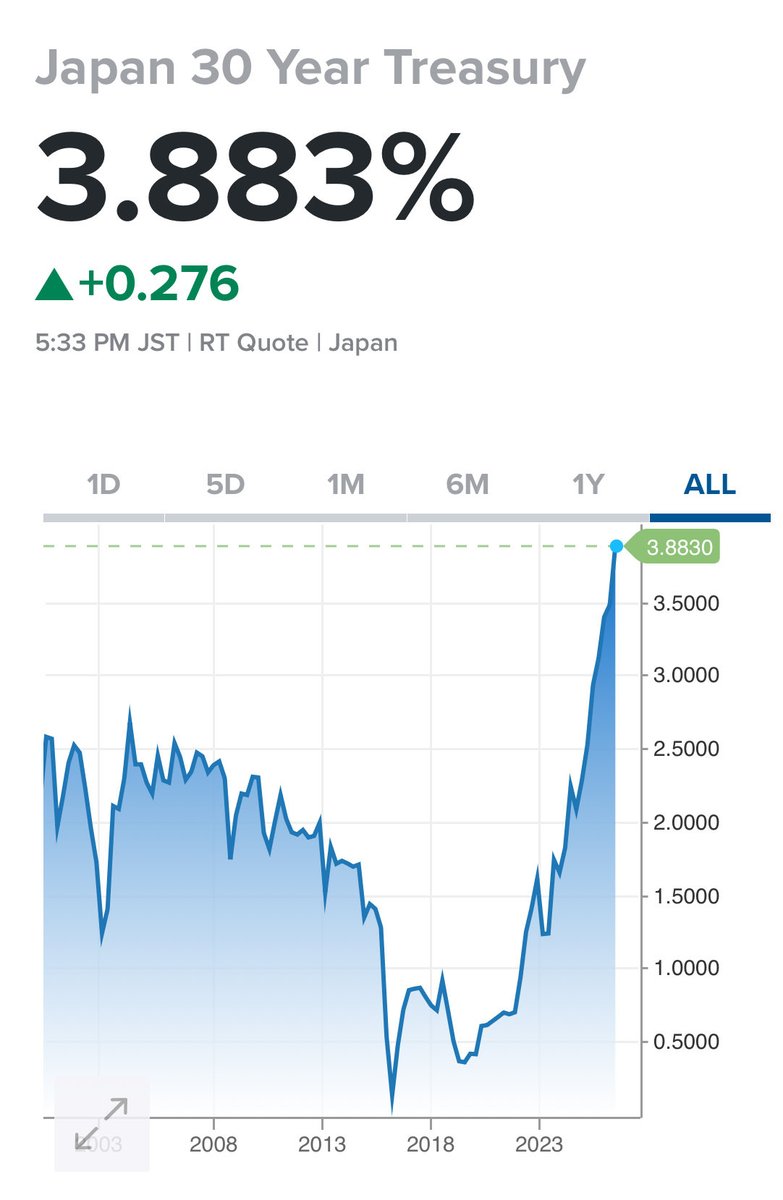 A synchronized global bond selloff. This is not just a Japan story: US 10-year Treasuries hover near 4.7%, UK gilts approach 5%, and German bunds are close to 3%. Meanwhile, the ownership structure of US debt is changing — foreign official holders (including China) keep trimming dollar assets, leaving price-sensitive private buyers to absorb supply. That makes Treasury yields more prone to rising — and more volatile.
What It Means for Global Markets
Carry-trade unwind risk. Japan is the world's largest net creditor nation. Yen funding supports everything from US tech stocks to emerging-market bonds. As domestic yields approach 3%, overseas assets lose relative appeal, and repatriation pressure builds. Barron's put it vividly: decades of Japanese low rates acted as an "invisible subsidy" for deficit-dependent governments and companies worldwide — and that subsidy is ending. Your mortgage and portfolio are exposed. Global long-bond yields are the floor under all long-duration asset pricing. Raise the floor, and mortgage rates, corporate borrowing costs, and equity P/E denominators all move up together. This is why every sharp move in JGB yields puts Wall Street on edge — BOJ tightening triggered violent global swings back in 2024. A striking signal: Japanese bond yields now exceed the dividend yield of Japanese stocks for the first time since 2008. For conservative capital, simply staying home and earning ~3% risk-free has suddenly become a legitimate strategy.
What Should Investors Do?
1. Don't dismiss this as noise. Japan's rate rise is structural: inflation isn't going back, the BOJ is shrinking its balance sheet, and fiscal math no longer works at zero rates. Plan asset allocation on a decade-long horizon.
2. Audit your rate sensitivity. Long-duration bond ETFs, high-multiple growth stocks, and REITs are the assets most exposed when yields climb.
3. Watch the yen and carry trades. If repatriation accelerates and the yen rallies sharply, risk assets could see another August-2024-style air pocket. Diversification, cash buffers, and low leverage remain the basics.
FAQ
Q1: Why does Japan's rate rise move global markets?A: Japan is the world's largest net creditor and supplier of cheap funding. Higher domestic yields pull money home, forcing carry trades to unwind — selling US equities and EM assets along the way, which transmits volatility across borders.
Q2: What does China reducing US Treasury holdings have to do with Japan?A: Both trends point the same direction: the traditional buyer base of US debt is eroding. Foreign officials are selling while price-sensitive private buyers take over, demanding higher yields; Japan's repatriation adds fuel. Together they push up global long-end rates.
Q3: Should I sell my bonds or bond ETFs as yields rise?A: Depends on duration and purpose. Long-duration bonds suffer mark-to-market losses when rates rise; if you hold short or ladder maturities to collect coupons, impact is limited. Review your portfolio's duration rather than panic-selling.
Q4: Why would the BOJ allow yields to reach 3%?A: Japanese core inflation has run above the 2% target for years, meaning real rates are still negative. The BOJ must normalize gradually to anchor inflation expectations and defend the yen — the market is simply moving faster than the central bank.
Q5: Is now a good time to invest in Japanese assets?A: Rising rates favor Japanese banks (wider lending margins) but hurt leveraged corporates and real estate; a stronger yen boosts returns for foreign investors holding yen-denominated assets. Think in terms of sub-sectors, not blanket bullishness or bearishness on Japan.
留言
張貼留言