FDA Approves the First Gene Therapy for Young Children with Sickle Cell Disease: Can One Treatment Really Change a Child's Life?
One-sentence takeaway: The FDA has extended sickle cell gene therapy to children as young as 2 — turning a lifetime of recurrent pain and hospital stays into a possible "one-time cure" — but the real fight ahead is price and access.

In early July 2026, the FDA approved the first gene therapy for young children with sickle cell disease (SCD), lowering the treatment age to 2 and up. Until now, these therapies were only available to patients 12 and older — yet the root of the disease takes hold in infancy.
Sickle Cell Disease: Why "One Treatment" Is a Historic Breakthrough
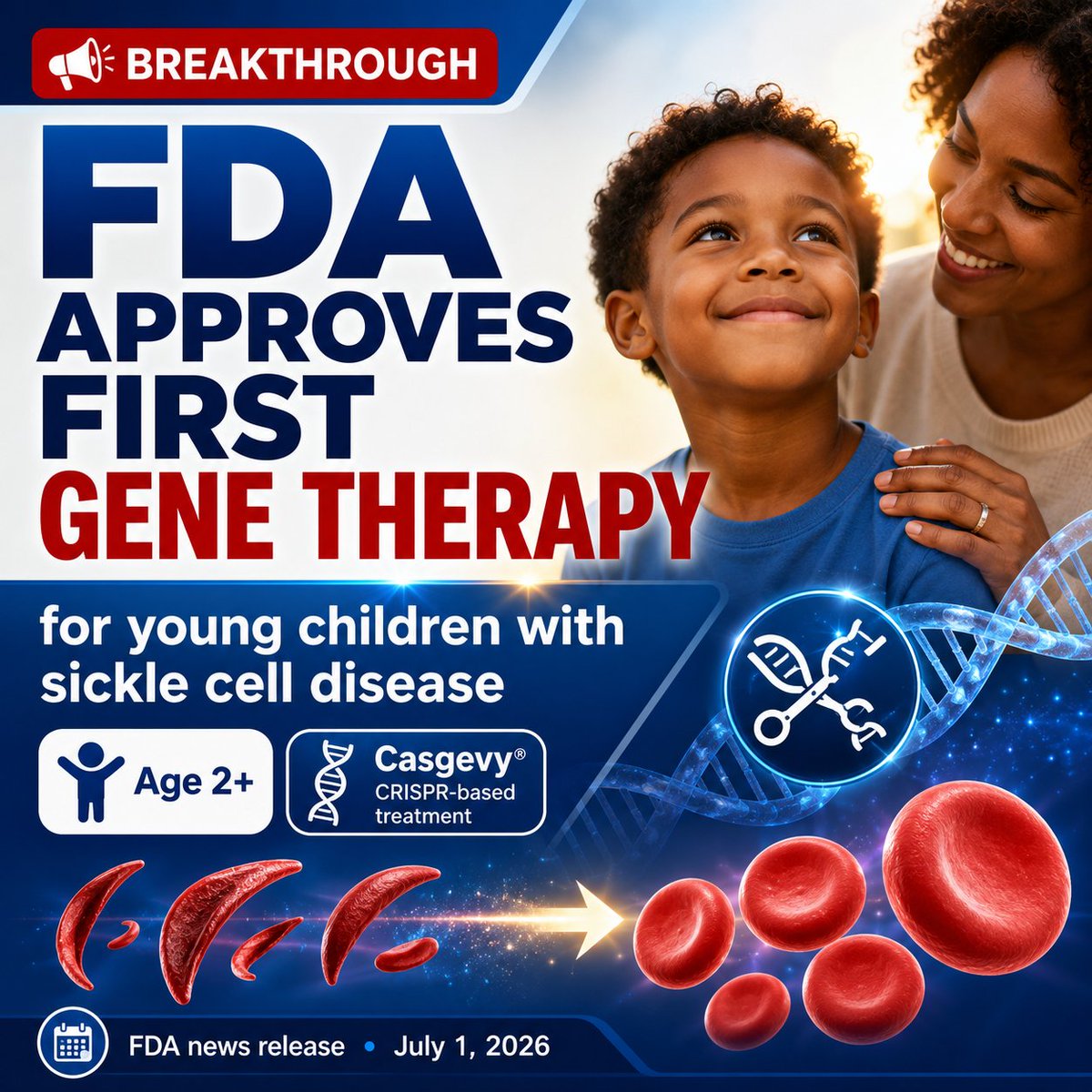
Sickle cell disease is one of the most common inherited blood disorders. Patients' red blood cells deform into "sickle" shapes that clog vessels, causing excruciating pain, organ damage, and infection risk. Hundreds of thousands of newborns worldwide are born with the defect each year; for patients, the norm is repeated hospitalization, lifelong pain management, and a dramatically shortened lifespan.
The only previous "cure" was bone marrow transplant — requiring a matched donor, with high risk and barriers. Gene therapy changes the game: no donor needed. Stem cells are taken from the patient's own body, their defective gene is repaired in the lab with CRISPR gene editing, and the corrected cells are infused back — letting patients heal with their own cells.
From 12 to 2: Why Lowering the Age Matters So Much

Casgevy — the CRISPR-based therapy developed by Vertex and CRISPR Therapeutics — was first approved for patients 12 and older in late 2023, and England's NICE followed in January 2025. The FDA's new expansion to ages 2 and up matters because sickle cell organ damage is cumulative: every vaso-occlusive episode inflicts irreversible harm on the spleen, lungs, and kidneys. The earlier treatment happens, the more damage a child avoids.
A 13-year-old Nashville teen's story captures the stakes: years of recurring "pain crises" and emergency visits, followed by gene therapy that made him a celebrated recovery case in his community. For families, this is no longer just "managing symptoms" — it's a chance to leave pain behind entirely.
One Treatment, Two Battles: Price and Access
The therapy's promise is thrilling, but the reality is sobering: a single treatment can cost millions of dollars and requires top-tier medical centers with cell-processing capabilities. In the developing world — especially Africa, where sickle cell disease is most prevalent — most families simply cannot afford it. That's why public health experts applaud the FDA's decision while pushing the same message: bring the price of a "cure" down to what everyone can pay.
Conclusion
This FDA approval means more than "one more drug" — it marks gene editing's formal entry into the pediatric era: stopping the disease at its source before organ damage accumulates, while children are still growing. Technically, "one-time treatment" is no longer a slogan. What determines the fate of hundreds of thousands of newborns next is price, infrastructure, and global access — a harder battlefield than any laboratory.
FAQ
Q1: What is sickle cell disease, and why does it mainly affect certain groups?It's an inherited red blood cell disorder where cells deform into sickle shapes, clogging vessels and causing pain and organ damage. Carriers are concentrated in malaria-prone regions (African, Mediterranean, Middle Eastern, and South Asian ancestry) because the sickle trait once offered partial protection against malaria — the evolutionary reason it's so common in these populations.
Q2: How does Casgevy's gene therapy work?Stem cells are collected from the patient's own bone marrow, CRISPR gene editing "switches on" the fetal hemoglobin gene in the lab (producing a hemoglobin that doesn't sickle), and the corrected cells are infused back into the patient. It resembles a bone marrow transplant — but without needing a donor.
Q3: Is one treatment really a permanent cure?Clinical data shows most treated patients remain free of pain crises and transfusions for years of follow-up. But "permanent" still requires longer-term tracking; the procedure itself carries risks like chemotherapy conditioning, so it's not for everyone.
Q4: How much does gene therapy cost, and will insurance cover it?A single treatment can run millions of dollars. Some US insurers and government programs have begun covering it, but coverage varies by policy; in most countries the therapy remains beyond individual reach, and health systems are exploring payment and installment mechanisms.
Q5: Why is the FDA's "ages 2 and up" approval so significant?Sickle cell organ damage is cumulative — the earlier treatment intervenes, the less vessel blockage and organ injury a child accumulates. Lowering the age to 2 means treatment can happen before severe complications set in, letting children grow up with already-repaired blood.
留言
張貼留言