One-line conclusion: China's largest DRAM maker CXMT is heading to the capital markets with a record offering — and the memory industry's competitive map is quietly shifting from a "Big Three" oligopoly to a four-way brawl.
An $8.5B+ IPO that shook the memory world
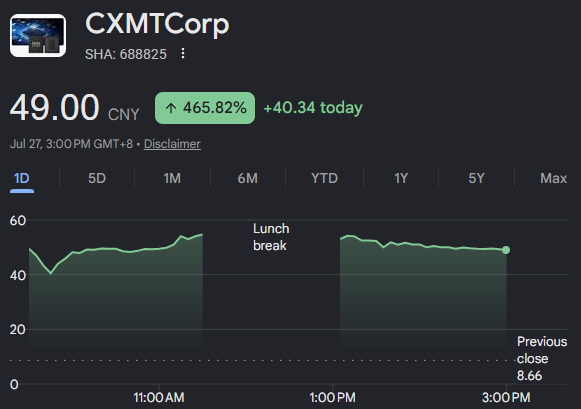
In August 2026, CXMT (ChangXin Memory Technologies), China's flagship DRAM maker, launched an IPO reportedly raising $8.5–9.9 billion — one of the largest memory-industry listings this year. On its first trading day, shares surged +465%, pushing the company's market cap from roughly $85.5 billion during the IPO process toward $500 billion — briefly making it the most valuable listed company in China.
The news rippled through global memory stocks: Micron fell on the day, and Wall Street began debating whether the DRAM bull cycle was cracking. Barron's noted "Micron drops as Chinese IPO adds pressure," while TradingKey asked whether the DRAM upcycle was ending.
Who is CXMT, and how far has its technology come?
Founded in 2016, CXMT is the flagship of China's DRAM localization drive. Over the years it moved from DDR4 toward DDR5, steadily raising yields and market share. Goldman Sachs initiated coverage in August 2026 with a Buy rating and a 12-month price target of RMB 129 (more than double the then-current price).
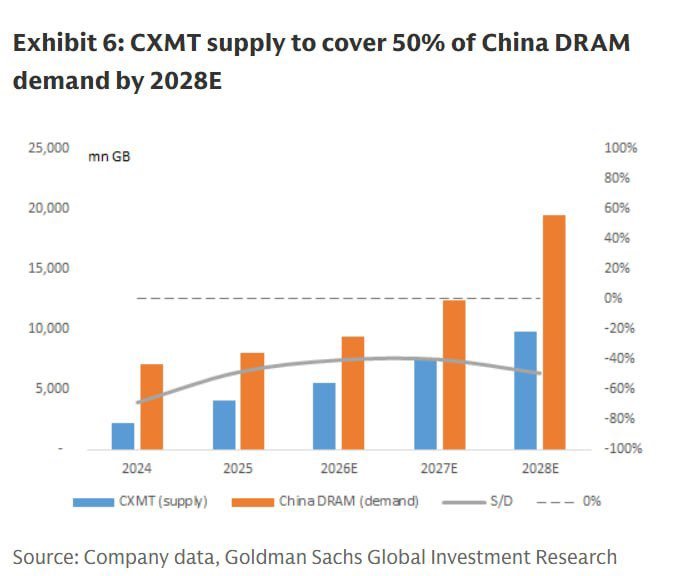
Goldman projects CXMT's DRAM supply will reach 41% of Samsung's and 50% of SK Hynix's by 2028 (up from 28% and 35% in 2025), and cover about half of China's DRAM demand. Output is climbing steadily from a base of 2,500 million GB — this is no longer a paper tiger but a real supply-side threat.
Why are the DRAM Big Three nervous?
Samsung, SK Hynix, and Micron control more than 95% of the global DRAM market. CXMT threatens them on three fronts:
1. Supply structure changes: If CXMT's output grows as Goldman projects, DRAM goes from "Big Three" to "Big Four," breaking the pricing discipline that has underpinned the oligopoly — the risk of a price war rises.
2. Overlapping demand: CXMT targets DDR4/DDR5 — the high-volume markets for consumer electronics and servers — colliding head-on with the incumbents, who are shifting focus toward AI-driven HBM (high-bandwidth memory), leaving their mid- and low-end defense thinner.
3. Geopolitical tailwinds: US export controls on Chinese semiconductors keep tightening, which paradoxically accelerates domestic substitution — CXMT enjoys policy support, capital, and order books that won't run dry.
How real is the threat under US export controls?
In August 2026, a former Samsung engineer who worked for 28 years and later helped found CXMT testified in a Seoul court that CXMT was established in 2016 with a plan to acquire Samsung's core DRAM process technology; he was ultimately sentenced to seven years in prison. Whatever the litigation outcome, the case reflects a strategic reality: China's memory self-sufficiency is a national project, not a slogan.
The key question for investors is whether CXMT can keep closing the gap in yields and costs. It still trails badly in high-end HBM, but its "price disruptor" role in low-end memory is already established — exactly the scenario the Big Three least want to see.
What it means for memory investors
In the short term, the CXMT listing may cap DRAM stock valuations (Micron already fell on the day). Longer term, the AI-driven HBM supercycle continues, and the incumbents' high-end moats won't crumble overnight. For retail investors, the pragmatic playbook:
- Don't trade headlines: Micron dipping below $900 doesn't necessarily mean broken fundamentals — check HBM supply/demand, inventory, and pricing data first.
- Watch the structural shift to "Big Four": If CXMT's yields keep climbing, the long-term price floor for mid- and low-end DRAM could drift lower, affecting every player.
- Diversify: Memory is a deeply cyclical industry; single-stock concentration is dangerous. Position in tranches and respect stop-losses.
Conclusion: not "whether," but "how fast"
CXMT's listing is not a question of "whether" but of "how fast." The memory industry's competitive map is being redrawn — the Big Three still own the high end, but pricing power in the low end is changing hands. Understanding this structural shift matters more than chasing daily moves.
FAQ
Q1: How far is CXMT's technology behind Samsung and SK Hynix?It still trails by one to two generations in high-end HBM, but DDR4/DDR5 yields keep improving. Goldman projects its DRAM supply will reach 41% of Samsung's and 50% of SK Hynix's by 2028.
Q2: How much will China's memory self-sufficiency affect global pricing?Pressure on mid- and low-end DRAM pricing is clearly rising, and the long-term price floor may drift lower; high-end HBM remains dominated by the Big Three for now due to technical barriers and customer qualification.
Q3: Why did CXMT's IPO drag Micron down?Markets fear that added supply will break the Big Three's pricing discipline, and the "Chinese IPO pressure" narrative weighed on DRAM valuations short term.
Q4: How big is CXMT's IPO, exactly?Reports cite roughly $8.5–9.9 billion raised; the first-day gain was +465%, pushing market cap toward $500 billion, briefly the highest of any listed Chinese company.
Q5: Should I still buy memory stocks now?Memory is a highly cyclical sector — base decisions on industry data (supply/demand, inventory, pricing), not sentiment. In high volatility, tranche entries and stop-losses beat predictions.
#CXMT #DRAM #Semiconductor #Memory #IPO #Micron #Samsung #SKHynix #ChinaTech
留言
張貼留言