One-sentence takeaway: The four hyperscalers' combined $400 billion annual capital expenditure is a bet — not on compute itself, but on whether AI applications can actually sell that compute once depreciation kicks in.

In 2026, the loudest number in global capital markets is not any company's revenue — it's the combined $400+ billion in annual capital expenditure guidance from the four cloud giants: Microsoft, Amazon, Google, and Meta. Meta has guided roughly $114–119 billion, Microsoft's FY2026 plan tops $90 billion, and Amazon already blew past $100 billion in 2025. Add Alphabet to the mix, and these four companies alone will outspend the entire annual budget of most mid-sized nations.
CapEx ≠ Revenue: The Accounting Trap
It's tempting to read surging capital expenditure as a sign of profitability — but accounting says otherwise. CapEx buys servers, GPUs, data centers, and power infrastructure, all of which are depreciated over 3 to 7 years. A single NVIDIA H100 server costs millions of dollars with a typical 5-year depreciation schedule — meaning the moment a data center goes live, massive depreciation charges start eating into quarterly earnings.
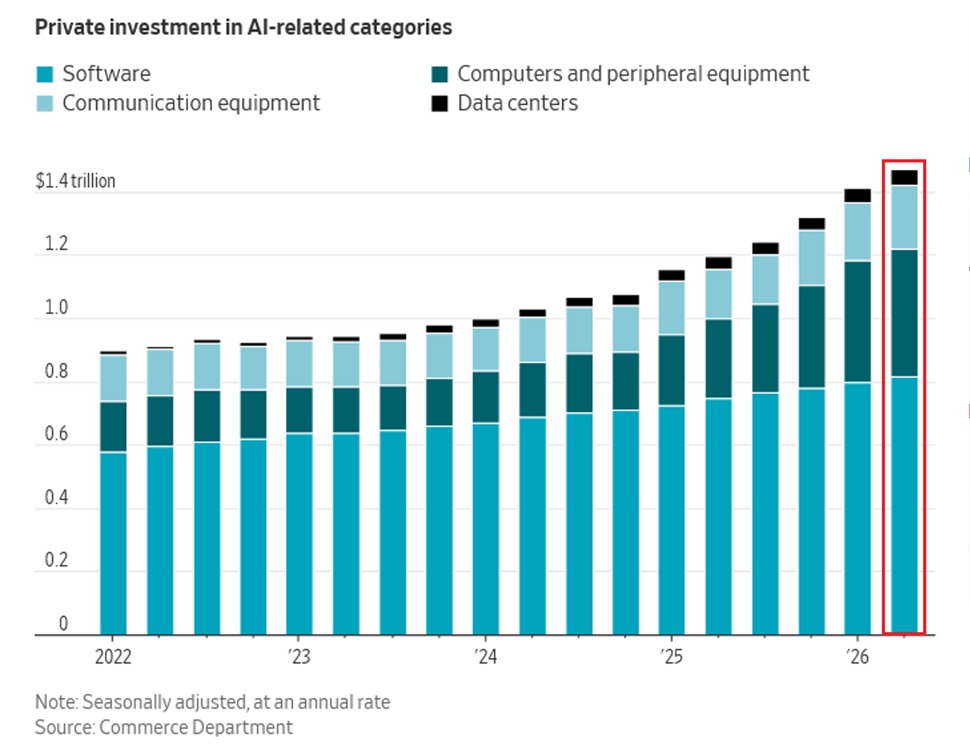
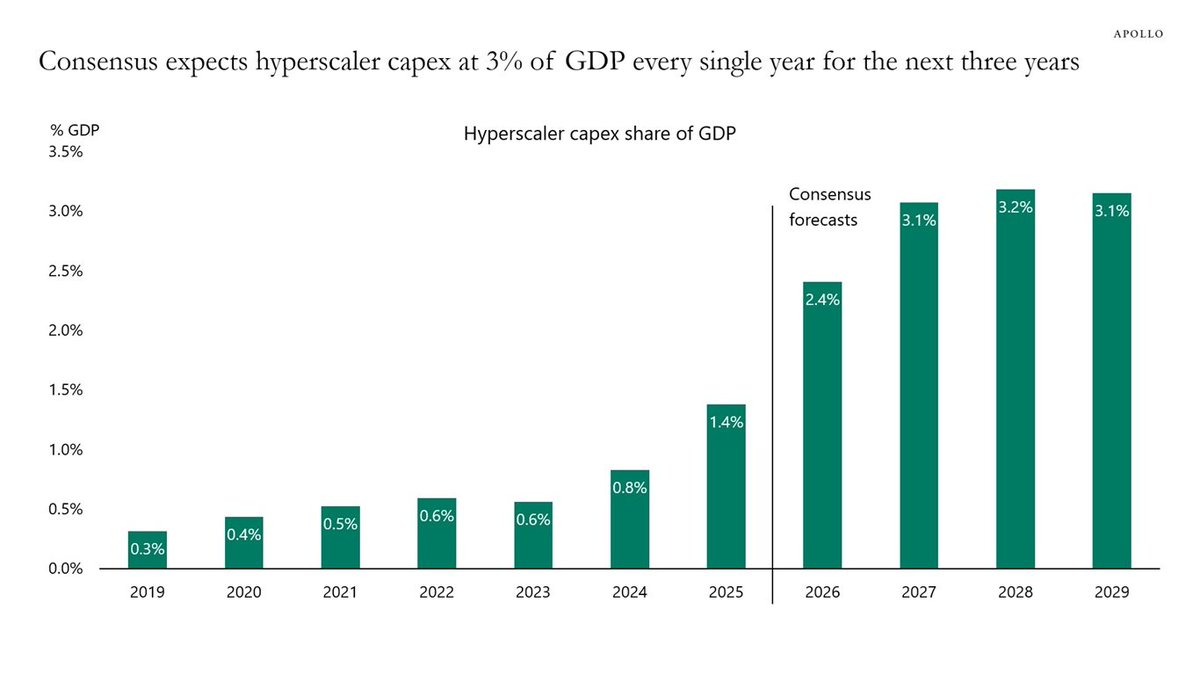
Apollo's chief economist Torsten Slok highlights a startling fact: data-center capex as a share of US GDP is set to jump from 1.4% in 2025 to 3.1% in 2027 — roughly 0.85 percentage points per year. That's nearly twice the pace of the housing boom at its fastest phase in the 2000s. Meanwhile, the Kobeissi Letter reports US private business investment in AI-related categories surged 25% year-over-year in Q2 2026, to a record $1.5 trillion annualized rate.
Bubble vs. Monetization: The Two Camps
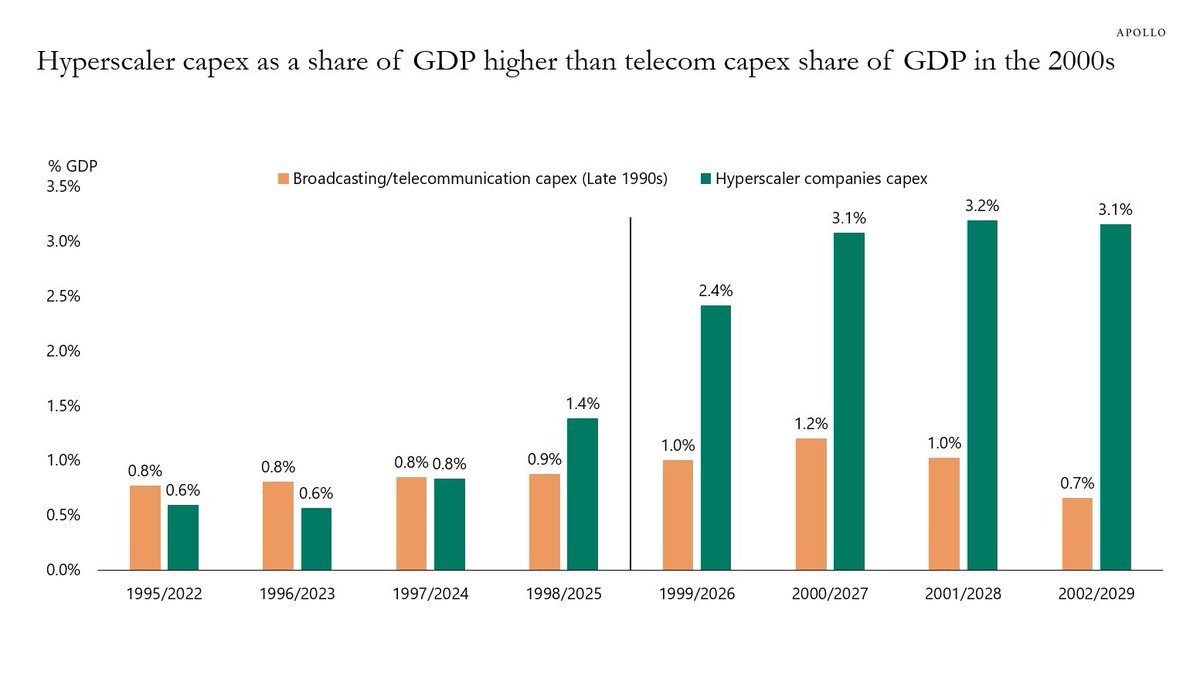 The bubble camp argues compute oversupply is inevitable. Planned power demand from global AI data centers already exceeds what several national grids can deliver. If inference demand can't keep pace with training expansion, idle compute becomes pure cash burn — and history is on their side: telecom capex collapsed in 2000, and industry leaders saw their stocks cut in half.
The monetization camp counters that this time is different: AI has moved from a training arms race into an application-revenue phase. Cloud growth rates have accelerated for several consecutive quarters, enterprise AI subscription penetration is rising, and inference revenue's share of cloud revenue keeps climbing — evidence that capex can convert into recurring income. And with the four hyperscalers' strong free cash flow, even a $400 billion splurge won't threaten their balance sheets.
The bubble camp argues compute oversupply is inevitable. Planned power demand from global AI data centers already exceeds what several national grids can deliver. If inference demand can't keep pace with training expansion, idle compute becomes pure cash burn — and history is on their side: telecom capex collapsed in 2000, and industry leaders saw their stocks cut in half.
The monetization camp counters that this time is different: AI has moved from a training arms race into an application-revenue phase. Cloud growth rates have accelerated for several consecutive quarters, enterprise AI subscription penetration is rising, and inference revenue's share of cloud revenue keeps climbing — evidence that capex can convert into recurring income. And with the four hyperscalers' strong free cash flow, even a $400 billion splurge won't threaten their balance sheets.
Three Leading Indicators to Watch
Instead of guessing when the bubble pops, track three quantifiable signals:
1. Cloud revenue growth: Whether the big three public clouds sustain 20%+ annual growth is the most direct demand check.
2. Inference revenue share: When usage-based inference revenue grows as a share of cloud revenue, compute is being used, not hoarded.
3. Free cash flow: Companies that keep growing free cash flow through a capex supercycle are the ones with real moats.
The Bottom Line
Capex itself isn't a bubble — "capex with no revenue to show for it" is. The hyperscalers are betting $400 billion on the assumption that AI applications will explode. If that assumption holds, today's heavy depreciation becomes tomorrow's high margins. If it doesn't, the income statements after 2027 will be brutal. Rather than betting on the direction, investors should keep both eyes on cloud growth and free cash flow — the two lifelines.
FAQ
Q1: Why would higher capex actually push stock prices down?Because capex doesn't turn into revenue immediately — but it does turn into depreciation immediately. If revenue growth can't keep up, earnings per share get diluted, and the market punishes that.
Q2: Which leading indicators reveal an overheated AI buildout?Three key ones: decelerating cloud revenue growth, stalled inference revenue share, and free cash flow turning negative. When all three deteriorate at once, it's a warning.
Q3: What are the 2026 capex figures for each hyperscaler?Meta: roughly $114–119 billion. Microsoft FY2026: $90 billion+. Amazon: already past $100 billion in 2025. Combined with Alphabet, the four exceed $400 billion.
Q4: Will AI data centers repeat the 2000 telecom bubble?The key difference: telecom built first and asked questions later, while AI compute is already generating real revenue (cloud inference, enterprise subscriptions). As long as monetization keeps pace with expansion, it's not a bubble — but if inference demand stalls, history could rhyme.
Q5: How should ordinary investors participate in this trend?Diversified exposure through ETFs tracking the four hyperscalers beats betting on a single stock. And revisit the three leading indicators above regularly as your rebalancing signal.
留言
張貼留言