TSMC Revenue Hits Record High, But Why Are AI Giants' Cash Flows Turning Negative? A Chart Explaining the Winners and Losers in the Semiconductor Gold Rush
One-line conclusion: Amid the AI infrastructure boom, TSMC's Q2 revenue hit a record NT$1.27 trillion, while Amazon, Google, Meta and other tech giants saw their free cash flows turn negative for the first time—the great "gold shovel sellers winning, gold diggers losing" transfer is underway.
On July 13, 2026, TSMC released staggering June revenue figures: NT$442.68 billion for the month alone, up 67.9% year-over-year, marking the highest monthly revenue in the company's history. First-half revenue reached NT$2.4 trillion, up 35.6%.
But this isn't just a beautiful earnings report. It reveals a far more dramatic story—a wealth transfer unprecedented in scale, driven by the global AI arms race.
Shovel Sellers vs. Gold Diggers
Picture the California Gold Rush of 1849. The people who got richest weren't necessarily the ones who struck gold—they were the ones selling picks, shovels, and blue jeans.
Today's AI industry plays out the same script.
Amazon, Google, Meta, Microsoft, and Oracle are expected to spend roughly $1.8 trillion on AI-related capital expenditures in 2026 and 2027 combined. They're building data centers, buying GPUs, laying fiber—burning cash at an almost incomprehensible rate.
And according to a viral post by financial analyst Kobeissi Letter (over 845,000 views, 5,000 likes), here's the shocking contrast:
Nvidia, Micron, Broadcom, and Applied Materials are expected to generate a record $430 billion in combined free cash flow over the next 12 months—more than triple what they generated just two years ago.
Meanwhile, the combined free cash flow of those five tech giants is projected to turn negative for the first time on record.
This is the first time in history we've seen such a stark "wealth scissors": chipmakers becoming cash-printing machines while AI pioneers become cash-burning ones.
 Source: Kobeissi Letter tweet chart showing the generational transfer of free cash flow
TSMC: The World's Only Unavoidable Fortress
Why is TSMC at the center of this storm?
Because no matter whose AI chip is strongest—Nvidia's H200, AMD's MI400, or even Google's custom TPU—they all must be manufactured at TSMC's fabs. TSMC controls over 73% of the global advanced foundry market, with 3nm capacity running at full tilt and 8nm and 5nm expanding rapidly.
More dramatically, TSMC's June data broke four years of seasonal patterns. Historically, June revenue declines about 11% month-over-month. This year, it grew 6.2% instead. AI demand has become so powerful it has overcome the semiconductor industry's own seasonality.
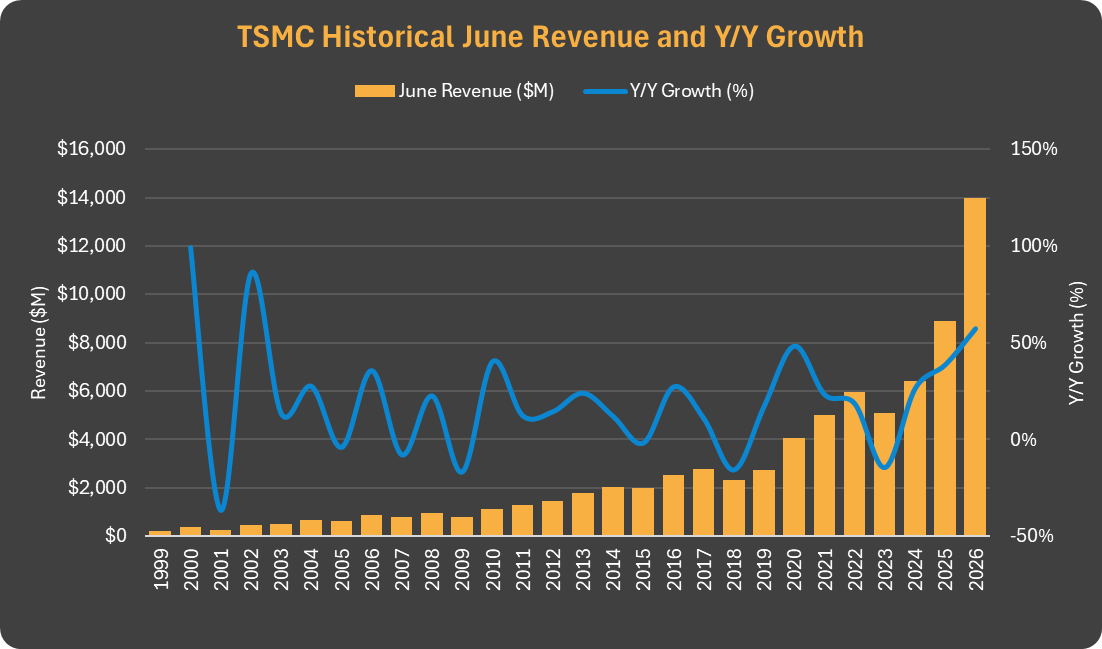 Source: SemiAnalysis analyst data, TSMC's fourth consecutive quarterly revenue record in 2026
Who's Burning Money? Who's Making It?
Let's break this down more clearly:
The earners (chip manufacturers):- Nvidia: Dominant AI training chip maker, H100/H200供不应求
- TSMC: Exclusive advanced process supplier, Q2 revenue NT$1.27 trillion
- Broadcom: Custom AI chips + optical networking
- Micron: HBM memory demand exploding
- Applied Materials: Semiconductor equipment leader
- Amazon: Massive AWS AI infrastructure expansion
- Google: TPU clusters + data centers
- Meta: Zuckerberg's "NeoCloud" plan + data centers
- Microsoft: Azure AI services
- Oracle: AI cloud services
The question is: when these tech giants' cash flows turn negative, how do they pay the bills?
The answer is simple and alarming: issuing stock (diluting shareholders) and issuing bonds (increasing debt). Neither path is healthy.
How Long Can This Fire Burn?
The optimistic view: AI-driven productivity gains will eventually generate massive revenue. Microsoft's cash flow is projected to recover to $129 billion by 2029 and $165 billion by 2030.
The pessimistic view: if AI application monetization can't keep pace with infrastructure spending, this arms race could end with a major tech company's financial crisis.
Bank of America has already warned: a "generational transfer of free cash flow" is underway. When the gold diggers go bankrupt one by one while the shovel sellers grow richer—this pattern has never lasted.
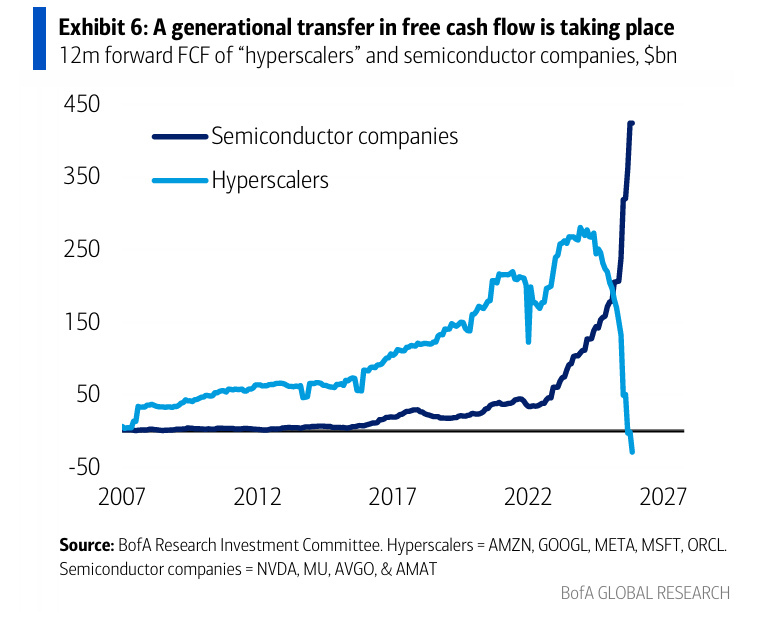 Source: Zero Hedge reposting Bank of America report on free cash flow transfer from app companies to chip makers
What This Means for Ordinary People
You might not be an investor or a semiconductor professional. But this matters to you:
1. Job opportunities: Semiconductor manufacturing and AI infrastructure roles continue growing, while AI application layers are seeing layoffs accelerate
2. Investment risk: Chip stocks may have already priced in excessive optimism
3. Tech costs: When tech giants issue bonds and dilute shares to fund AI investments, the ultimate cost gets passed to consumers
The beneficiaries of the AI revolution might not be who you think.
Frequently Asked Questions (FAQ)
Q1: Why is TSMC's June revenue so surprisingly high?A1: Mainly due to explosive AI chip demand—customers like Nvidia, AMD, and Apple rushed advanced process orders to Q2 delivery. Plus, June historically sees seasonal decline but grew 6.2% this year, breaking four years of seasonal recession patterns.
Q2: What does it mean that tech giants' cash flows are turning negative?A2: It means their AI infrastructure spending has exceeded cash earned from AI services. Amazon, Google, Meta and others are investing hundreds of billions annually in data centers and GPUs, but AI product monetization hasn't caught up.
Q3: How long will the AI arms race last?A3: According to consensus estimates, the five giants' combined AI capex in 2026-2027 totals about $1.8 trillion. But if a major giant experiences a financial crisis or regulatory intervention, the race could slow suddenly. History (like the 2000 dot-com bubble) shows such races typically end in bankruptcy waves.
Q4: How deep is TSMC's moat?A4: Extremely deep. TSMC controls over 73% of the global advanced process (below 7nm) market and operates the world's largest fab network. Even though its clients include all major chip designers (Nvidia, AMD, Apple), they have no viable second choice.
Q5: What's the investment takeaway?A5: Chip stocks have priced in enormous optimism. When the "shovel sellers" have made their fortune and the "gold diggers" are broke, the reversal in wealth transfer may come faster than anyone expects. Diversify and focus on companies with healthy cash flows.
Q6: Which AI giant is most likely to fall first?A6: Oracle currently has the worst AI ROI, followed by Meta (Zuckerberg's metaverse + AI dual bet). Amazon and Google, while burning cash, still have e-commerce and search businesses to support cash flow.
Q7: What role will China play?A7: China's AI chip self-sufficiency plans are accelerating, but constrained by advanced manufacturing capability. Huawei's Ascend chips and Cambricon's AI accelerators are the main competitors, but still 2-3 generations behind Nvidia in performance and ecosystem.
Tags: #TSMC #AI #semiconductors #chipinvestment #techstocks #freecashflow #Nvidia #AInfrastructure
留言
張貼留言