Thermodynamics Is Being Rewritten After 200 Years—A Physicist Just Used Quantum Field Theory to Fix Its Math
One-line conclusion: Physicist Bryan Roberts from the London School of Economics is rebuilding thermodynamics using gauge theory—a geometric framework typically reserved for quantum field theory—elevating thermodynamics from a collection of engineering rules of thumb into a mathematically rigorous fundamental science, with potential applications in nanoscale engineering and quantum computing.
Did you know that thermodynamics—one of the oldest and most practical branches of physics—has never had a fully rigorous mathematical foundation?
For 200 years, the laws of thermodynamics have powered technologies from car engines to household refrigerators. They work brilliantly in practice. But mathematically, they've relied more on intuition and engineering approximations than on precise derivations.
That is finally changing.
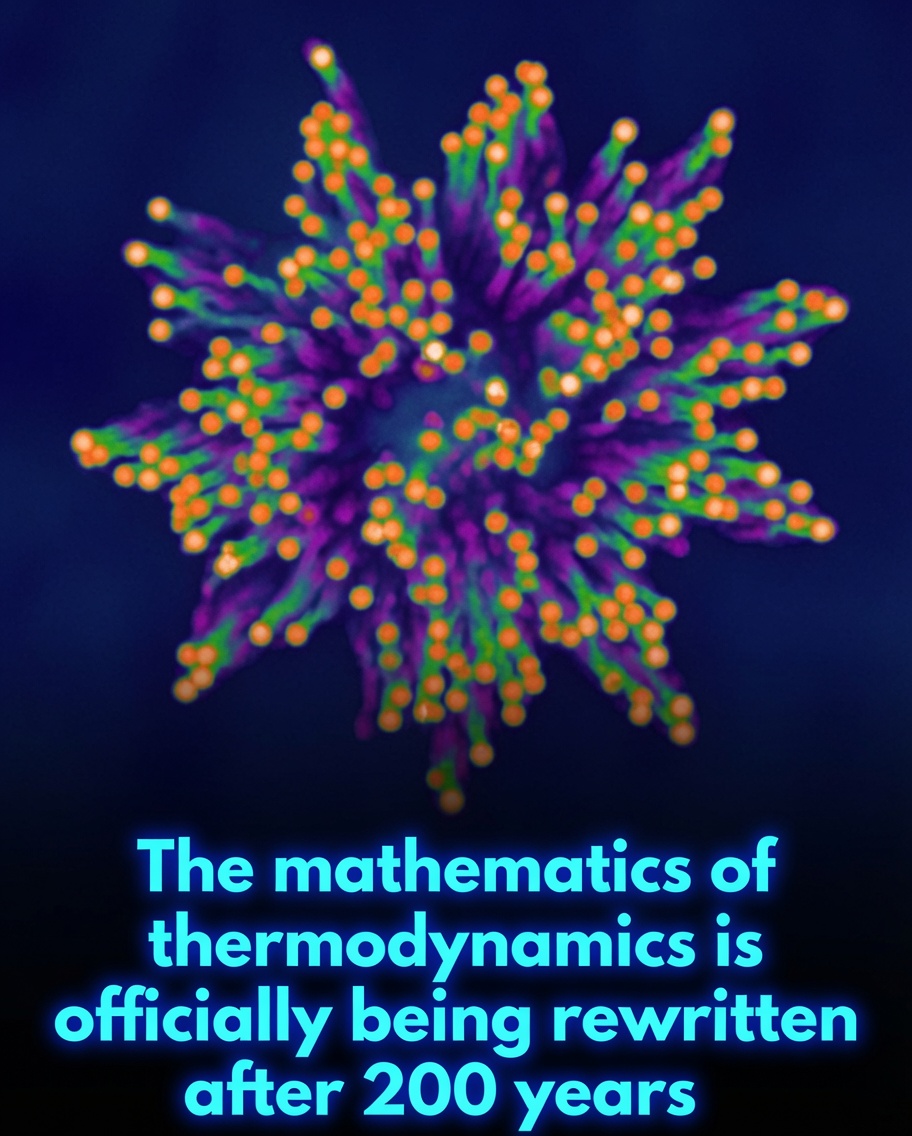
 Physicists are rewriting the 200-year-old mathematics of heat and work — Source: K. Padavic-Callaghan, New Scientist 2026
The Shadow Analogy: Understanding Gauge Theory
First, some context.
In physics, "gauge theory" is one of the most important mathematical tools of the last half-century. It's used to describe quantum field theory—the Standard Model of particle physics. The Standard Model predicted the Higgs boson and explains three of the four fundamental forces (electromagnetism, the weak force, and the strong force). It is humanity's most precise description of the microscopic world.
But gauge theory has always belonged to the realm of quantum mechanics. Nobody thought to apply it to everyday phenomena like heat and work.
Until Bryan Roberts came along.
His approach can be understood with a simple analogy:
Imagine you're in a dark room. You can't see the objects themselves—only their shadows on the wall. By studying the shapes, sizes, and movements of those shadows, you could infer the contours and positions of the hidden objects.Traditional thermodynamics is like "watching shadows"—observing macroscopic measurements like temperature, pressure, and volume (the shadows), then deriving relationships about heat and work.
Roberts' approach goes further: not just watching shadows, but using a rigorous geometric language to describe the precise relationship between shadows and the objects casting them. That geometric language is "gauge theory."
This creates a precise mathematical bridge between classical mechanics and the quantum scale, connecting observable thermodynamic phenomena directly to underlying quantum structures—without engineering approximations.
 Bryan Roberts (LSE) uses gauge theory to reconstruct thermodynamics — Source: Rainmaker1973 / Twitter
Why Does This Matter?
You might ask: thermodynamics already works perfectly. Why go through the trouble of rewriting it?
The answer is: "good enough" is not the same as "correct."
Consider this: Newtonian mechanics works perfectly for everyday speeds. But it fails at high velocities—a fact we only understood after Einstein's relativity. Similarly, when we want to design quantum computers or nanoscale devices, traditional thermodynamics' engineering approximations are no longer sufficient.
Roberts' framework addresses three fundamental problems:
1. A Rigorous Mathematical Foundation
Traditional thermodynamics relies on assumptions: ideal gases, uniform energy distributions, reversible processes. These assumptions are reasonable for engineering but not mathematically rigorous.
Roberts' gauge theory framework constructs a precise geometric structure for how heat and work interact. It's like replacing a wooden bridge with reinforced concrete—the load-bearing capacity is fundamentally different.
2. Bridging Macro and Micro
This is physics' long-standing dream: unifying classical mechanics (the world we see) with quantum mechanics (the rules of the microscopic world).
Roberts' method directly connects macroscopic observables (temperature, pressure) to unobservable quantum structures—no engineering approximations needed. It's like finding a "direct channel" between the macro and quantum worlds.
3. Nanotech and Quantum Computing Applications
This is the most practical impact.
When engineers design nanoscale engines or quantum computers, they constantly switch between thermodynamics and quantum mechanics, using approximations to bridge the gap. This is not only time-consuming but limits design possibilities.
With a unified gauge theory framework:
- Nano-engineers can calculate thermal efficiency of microscopic devices with unprecedented precision
- Quantum computer designers can better understand and control heat exchange between qubits and their environment
- Materials scientists can predict material behavior at quantum scales
 New Scientist report: Mathematics of thermodynamics is being rewritten after 200 years — Source: newscientist.com
This Doesn't Contradict Classical Thermodynamics
An important clarification: Roberts' theory does not overturn existing thermodynamics. It gives it a more solid foundation.
Just as Einstein's relativity didn't abolish Newtonian mechanics—Newton's laws are still correct at everyday speeds, but relativity provides a more precise description at extreme conditions—traditional thermodynamics remains valid for everyday and most engineering applications.
But for:
- Systems approaching quantum limits
- Ultra-low or ultra-high temperatures
- Nanoscale energy conversion
Roberts' gauge theory framework provides precision that traditional methods cannot achieve.
The Bigger Picture
This is more than a technical upgrade in physics.
It marks a shift in the evolution of physics: from practical to rigorous, from engineering to mathematics. Thermodynamics—humanity's oldest and most applied branch of physics—has finally gained the same mathematical status as quantum field theory and general relativity.
As the Rainmaker1973 account summarized (18,768 views, 78 likes):
"This represents a profound evolution in physical understanding, elevating thermodynamics from a collection of practical rules to a mathematically robust fundamental science."
Frequently Asked Questions (FAQ)
Q1: Did thermodynamics really have a math problem?A1: Not a "problem" per se, but an "incompleteness." Traditional thermodynamics relies on engineering assumptions and approximations that work well in practice but lack the rigorous derivation found in quantum field theory or relativity. Roberts' work fills this gap.
Q2: What is gauge theory?A2: Gauge theory is a mathematical framework that uses geometric language to describe physical laws. It was pioneered by Chen-Ning Yang and Robert Mills in the 1950s and forms the mathematical backbone of the Standard Model of particle physics.
Q3: How does this affect everyday life?A3: Short-term: not much. Long-term: it could enable more efficient nanoscale devices, more stable quantum computers, and more precise materials design. Eventually, this could influence everything from chip efficiency in your phone to cooling systems in your computer.
Q4: Has this theory been experimentally verified?A4: Currently it's a theoretical framework (arXiv 2507.12345 preprint), not yet experimentally tested. However, it's built on 70 years of established gauge theory mathematics. The next step is applying it to real physical systems for validation.
Q5: Who is Bryan Roberts?A5: A physicist at the London School of Economics and Political Science (LSE). His research focuses on quantum foundations and the mathematical structure of thermodynamics. The paper is single-author, published on arXiv (2507.12345), and covered by New Scientist.
Q6: Is this different from previous "thermodynamics breakthroughs"?A6: Yes. Unlike previous work that proposed local corrections to thermodynamics at quantum scales, Roberts' work is the first to use gauge theory—a mature geometric framework—to rebuild the entire theoretical foundation. It's not a patch—it's a reconstruction from the ground up.
Q7: Will this affect the thermodynamics formulas I need for exams?A7: No. Classical thermodynamics formulas remain correct for all normal conditions. In fact, Roberts' theory should derive all the classical formulas—that's the first step in confirming it's correct.
Tags: #Thermodynamics #GaugeTheory #Physics #QuantumMechanics #BryanRoberts #LSE #ScienceRevolution
留言
張貼留言