One-line conclusion: "SK Hynix posted a record 12x profit surge in Q2 2026, yet its stock tanked — not because the company faltered, but because AI mania inflated market expectations beyond reality."
Introduction: The Paradox of Profit
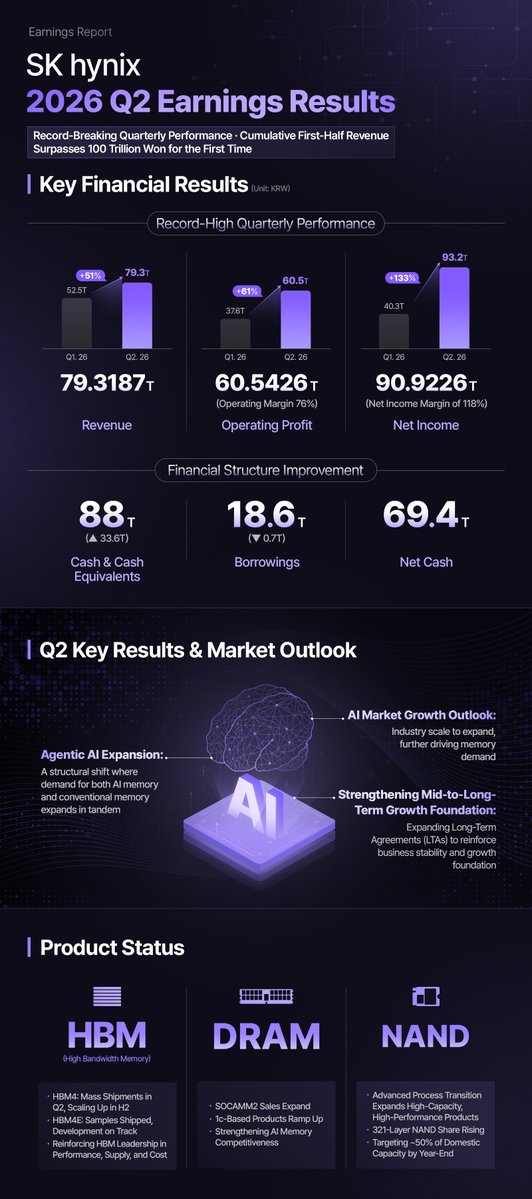
On July 29, 2026, SK Hynix reported its Q2 earnings: operating profit surged over 5x YoY to approximately 4.9 trillion KRW ($36B), with revenue hitting an all-time high of 16.4 trillion KRW ($120B).
The market's response? A brutal selloff that erased roughly $600 billion in market cap.
How does a company with record profits see its stock price collapse? The answer lies not in SK Hynix's performance, but in the "expectation inflation" gripping the entire AI semiconductor sector.
Earnings Breakdown: Record-Breaking, Yet Not Enough
Revenue Structure
Over 40% of SK Hynix's 16.4T KRW Q2 revenue came from HBM (High Bandwidth Memory) — the critical memory component powering AI server GPUs like NVIDIA's H200 and B200.
| Product Line | Q2 Revenue | YoY Growth |
|-------------|-----------|-----------|
| HBM (High Bandwidth Memory) | ~6.6T KRW | +280% |
| DRAM (Legacy) | ~5.7T KRW | +85% |
| NAND Flash | ~4.1T KRW | +45% |
The Disconnect
Analysts had expected SK Hynix's Q2 operating profit to reach 5.5T KRW or higher. The actual 4.9T — while up 12x YoY — missed consensus estimates by roughly 11%.
It's the equivalent of a student scoring 95 on an exam after getting an 8 last year — remarkable improvement, but "disappointing" because everyone expected a perfect 100.
HBM4: The Next-Generation Memory Battle
HBM4 Timeline
SK Hynix confirmed its HBM4 roadmap during the earnings call:
- H2 2026: HBM4 samples shipped to key customers (NVIDIA, AMD)
- H1 2027: HBM4 enters mass production
- 2028: HBM4e (enhanced version) development complete
HBM4 represents a critical leap: bandwidth is expected to increase by over 50% compared to HBM3E, with per-stack capacity rising from 24GB to 36GB+.
Competitive Landscape
SK Hynix currently holds approximately 53% of the HBM market, ahead of Samsung (~38%) and Micron (~9%). However, Samsung is accelerating its追赶 efforts, announcing plans to mass-produce its own HBM4 by end of 2026.
The three-way technology race is entering its most intense phase — whoever brings higher-performance HBM4 to market first will capture the largest share of the AI server memory market.
AI Capital Expenditure Anxiety: A Systemic Risk?
SK Hynix's selloff wasn't an isolated event. The same day, NVIDIA fell 3.2%, TSMC ADR dropped 2.8%, and South Korea's KOSPI recorded its biggest single-day decline since March.
The market's collective anxiety stems from one question: Is AI capital spending spiraling out of control?
By the Numbers
- Google 2026 CapEx: $205 billion (all-time high)
- Microsoft + Meta + Amazon combined AI spending: Over $300 billion
- NVIDIA single-quarter data center revenue: Over $30 billion
These staggering figures raise a legitimate concern: if AI application monetization can't keep pace with infrastructure expansion, the semiconductor industry could swing from "boom" straight to "bust."
Practical Advice for Investors
Short-Term (1-3 months)
Market sentiment will dominate near-term price action. SK Hynix and the broader semiconductor sector may remain under pressure. If you hold positions:
- Set clear stop-loss levels (e.g., another 10% decline)
- Avoid chasing dips during the earnings digestion period
Medium-Term (6-12 months)
HBM4 mass production and AI application adoption are the key catalysts to watch. Look for:
- HBM4 on schedule → SK Hynix fundamentals intact
- AI monetization accelerating → CapEx合理性 confirmed, semiconductors regain momentum
FAQ
Q1: Why did SK Hynix stock crash despite record profits?A: Market expectations had run ahead of reality. Analysts predicted 5.5T KRW in operating profit; the actual 4.9T, while historically extraordinary, fell short. This is a classic "high expectations trap" fueled by AI hype.
Q2: What's the difference between HBM4 and HBM3E?A: HBM4 offers approximately 50% more bandwidth and increases per-stack capacity from 24GB to 36GB+, specifically designed for next-generation AI GPUs.
Q3: Can Samsung catch up to SK Hynix?A: Samsung is accelerating its efforts, but SK Hynix maintains a 6-12 month lead in HBM process yield and customer qualification. The gap between the three players (SK, Samsung, Micron) is narrowing.
Q4: Is this semiconductor selloff a buying opportunity or a warning sign?A: It depends on your investment horizon. Short-term volatility is inevitable; medium-to-long term, AI infrastructure spending continues to grow and HBM demand hasn't peaked. For long-term investors, pullbacks in quality names can present opportunities.
Q5: When will HBM4 reach consumer products?A: Not anytime soon. HBM4 is designed for AI servers and data centers — the cost is prohibitive for consumer applications. Consumer memory will continue to rely on DDR5 and GDDR7.
Tags: #SKHynix #HBM4 #Semiconductors #AIChips #Memory #Investing #Earnings
留言
張貼留言