One-line conclusion: Researchers at La Trobe University have identified a completely new mechanism of viral transmission — when cells undergo programmed death, they release a molecular signal called "F-ApoEVs" that guides the immune system's cleanup crew. But influenza viruses can hitch a ride inside these signals, using the immune system's own cleanup route to infect healthy neighboring cells. This is a viral transmission pathway never seen before.
Every day, hundreds of billions of cells in your body die on schedule and are replaced. Keeping this biological "daily cleanup" running smoothly is essential to maintaining health.
But now, scientists have discovered a disturbing vulnerability in this process.
The Cell's "Footprint of Death"
Using 3D timelapse microscopy, a team at La Trobe's Institute for Molecular Science (LIMS) closely observed the entire process of apoptosis (programmed cell death).
What they found was unexpected.
When a cell dies, it releases a special type of extracellular vesicle (EV) — the team named it F-ApoEVs (footprint of death-derived, apoptosis-triggered extracellular vesicles).
Think of it as a trail of breadcrumbs the cell leaves behind — the immune system follows these traces to find and clean up dead cells. Without this mechanism, dead cell fragments would accumulate, triggering inflammation and autoimmune diseases like Systemic Lupus Erythematosus (SLE).
"Billions of cells are programmed to die each day as a part of normal turnover and disease progression. Until now, it was believed that cell fragmentation during cell death was random and fairly simple. Our findings demonstrate the complexity of this process — each step is critical to help the dying cell break down efficiently." — Dr. Ivan Poon, LIMS biochemist
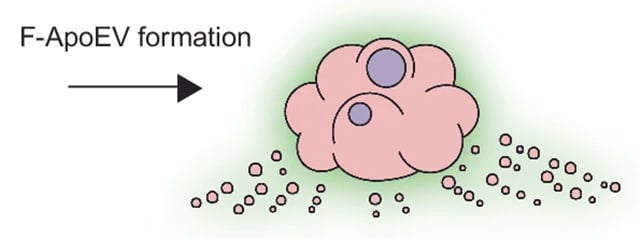 F-ApoEVs (small pink blobs) left behind by dying cells — a newly discovered type of extracellular vesicle (Source: Rutter et al., Nature Communications, 2026)
How Viruses Hijack This Mechanism
The researchers infected dying cells with influenza virus and tracked what happened.
The result was startling.
"What we didn't expect was how viruses can also take advantage of this process — they hide their particles inside F-ApoEVs, and as the immune system cleans up after the cell, these pathogen fragments get spread to neighboring, healthy cells."
This is an entirely new way for viruses to spread.
Traditionally, we know viruses spread through:
1. Droplet transmission (coughing, sneezing)
2. Contact transmission (touching infected surfaces)
3. Airborne transmission (aerosols)
4. Bloodborne transmission (blood, bodily fluids)
5. Vertical transmission (mother to child)
This newly discovered mechanism is fundamentally different — viruses disguise themselves as "dead cell debris," tricking the immune system into transporting them to new cells.
Lead researcher Dr. Stephanie Rutter noted: "We know the body clears away dead cell fragments to prevent them from causing inflammation and autoimmune diseases. We saw F-ApoEVs are readily cleared from the site of cell death. What we didn't expect was that viruses could also take advantage of this process."
Why This Matters
This discovery has implications across three dimensions of medical research:
1. Rethinking Viral Transmission
If influenza can spread this way, what about other viruses? SARS-CoV-2, HIV, even Ebola — do they also exploit the "footprint of death" pathway? This demands extensive follow-up research.
2. New Perspective on Autoimmune Diseases
The rapid clearance of F-ApoEVs is critical for preventing autoimmune disease. If this clearance process malfunctions, it could lead to conditions like SLE. Enhancing F-ApoEV function might help protect against autoimmune diseases.
3. New Direction for Drug Development
The study suggests future drug treatments could harness F-ApoEVs, or prevent viruses from infiltrating them — opening an entirely new class of antiviral strategies.
 ScienceAlert: Newly discovered 'Footprint of Death' may help viruses spread — a hidden threat revealed
 Apoptosis (programmed cell death) — scientists discovered viruses can hide inside the vesicles released by dying cells to spread to healthy neighbors
The Beauty of Scientific Serendipity
What makes this study particularly fascinating is how much of it was accidental.
The research team initially set out to understand how cells communicate after death — how dying cells talk to the immune system. They had no expectation of discovering a completely new viral transmission pathway.
"This study has revealed that dying cells can continue to communicate from the grave and may impact immune function." — Dr. Georgia Atkin-Smith, Walter and Eliza Hall Institute
Cell biologist Georgia Atkin-Smith's words reveal a profound truth: death is not a cell's last word to the body.
Those cells that have already died continue to influence surrounding cells, the immune system, and even — the fate of viruses.
FAQ
Q1: What exactly are F-ApoEVs?A1: F-ApoEVs (Footprint of death-derived, Apoptosis-triggered Extracellular Vesicles) are a newly discovered type of vesicle. When a cell undergoes programmed death (apoptosis), it releases these tiny packets that serve as "signposts" guiding the immune system to clean up the dead cell.
Q2: Does this discovery make influenza more dangerous?A2: No. This discovery doesn't change influenza's inherent danger. It simply reveals a transmission pathway we didn't know existed. This is important for future antiviral drug and vaccine development.
Q3: Could this explain why some viruses spread so easily?A3: Possibly. Researchers speculate that highly transmissible viruses like influenza and COVID-19 may exploit the F-ApoEV pathway as a "shortcut." But this requires further confirmation.
Q4: Is this being used in clinical treatment yet?A4: Far from it. This is fundamental science — a basic discovery that opens new directions for drug development. Scientists need to fully understand the F-ApoEV mechanism first.
Q5: What are the implications for COVID-19 research?A5: While this study used influenza, the mechanism may be universal. Other viruses, including SARS-CoV-2, may also exploit F-ApoEVs. Follow-up studies are exploring this direction.
Q6: What is apoptosis?A6: Apoptosis is programmed cell death — like a building being demolished in a controlled, planned manner. It's the body's normal mechanism for removing damaged, aged, or unnecessary cells, distinct from necrosis (uncontrolled cell death).
Tags: #ViralTransmission #FootprintOfDeath #FApoEVs #Apoptosis #MedicalBreakthrough #NatureCommunications #Influenza
留言
張貼留言