One-line conclusion: The Philadelphia Semiconductor Index (SOX) has plunged over 20% from its all-time high, entering a technical bear market for only the 8th time in history — Micron dropped 20% in a month, memory leveraged ETFs hemorrhaged $10 billion, and CoreWeave started hedging chip prices. Yet semiconductor earnings estimates are at record highs. It's either the buying opportunity of the year, or the market knows something the analysts don't.
On July 17, 2026, the Nasdaq Composite sank 1.4% for a second consecutive session. Semiconductor stocks led the rout.
Google Trends data from Taiwan shows "Philadelphia Semiconductor" hit a staggering 50,000+ search intensity — a signal of collective panic among retail investors. Micron (MU), NVIDIA (NVDA), and TSMC (TSM) all trended simultaneously.
This isn't a normal pullback. It's an inflection point for the entire semiconductor narrative.
Layer 1: SOX Technical Bear Market — What History Says
The Philadelphia Semiconductor Index has dropped over 20% from its high, officially entering a technical bear market. This has only happened 8 times in SOX history.
The last time it happened, SOX ultimately fell 40% and took 249 days to bottom.
But here's what's different:
"The great semiconductor disconnect: SOX earnings estimates keep climbing to fresh records, while chip stocks are tumbling. The index is now ~20% below its peak even as forward profits hit new highs. Either this is a buying opportunity — or the market knows something analysts don't." — Holger Zschäpitz, Market Reporter at Welt
This is a classic earnings-versus-price disconnect.
 SOX index down 20% from highs while forward earnings hit records — one of the biggest disconnects ever (Source: Holger Zschäpitz / Welt)
 SOX entering technical bear market for only 8th time — last time it fell 40% before bottoming
Layer 2: Memory Chips — The Unwind of the Most Crowded Trade
Among all semiconductor stocks, memory chips got hit the hardest.
Micron dropped 20% in a month. SanDisk fared worse. But the metric that really caught Wall Street's attention: the massive unwind in memory single-stock leveraged ETFs.
Since their June peak, assets in memory single-stock leveraged ETFs have collapsed by over $10 billion (-35%). These funds track Kioxia, Micron, Samsung, SanDisk, and SK Hynix.For comparison, all leveraged equity ETFs declined just 13% over the same period.
One analyst noted: "The speed of this unwind highlights just how crowded and fragile the AI-driven memory chip trade had become."
And then came the hammer: CoreWeave, the AI cloud giant, was reported to be exploring financial derivatives to hedge against potential declines in memory chip prices. Evercore ISI analysts noted this was "being read by investors as a sign that memory prices may be approaching a peak."
But here's the contradiction: Evercore's own channel checks "suggest DRAM/NAND constraints will likely worsen exiting CY26 and persist through most of CY27."
In other words — short-term panic, unchanged long-term fundamentals.
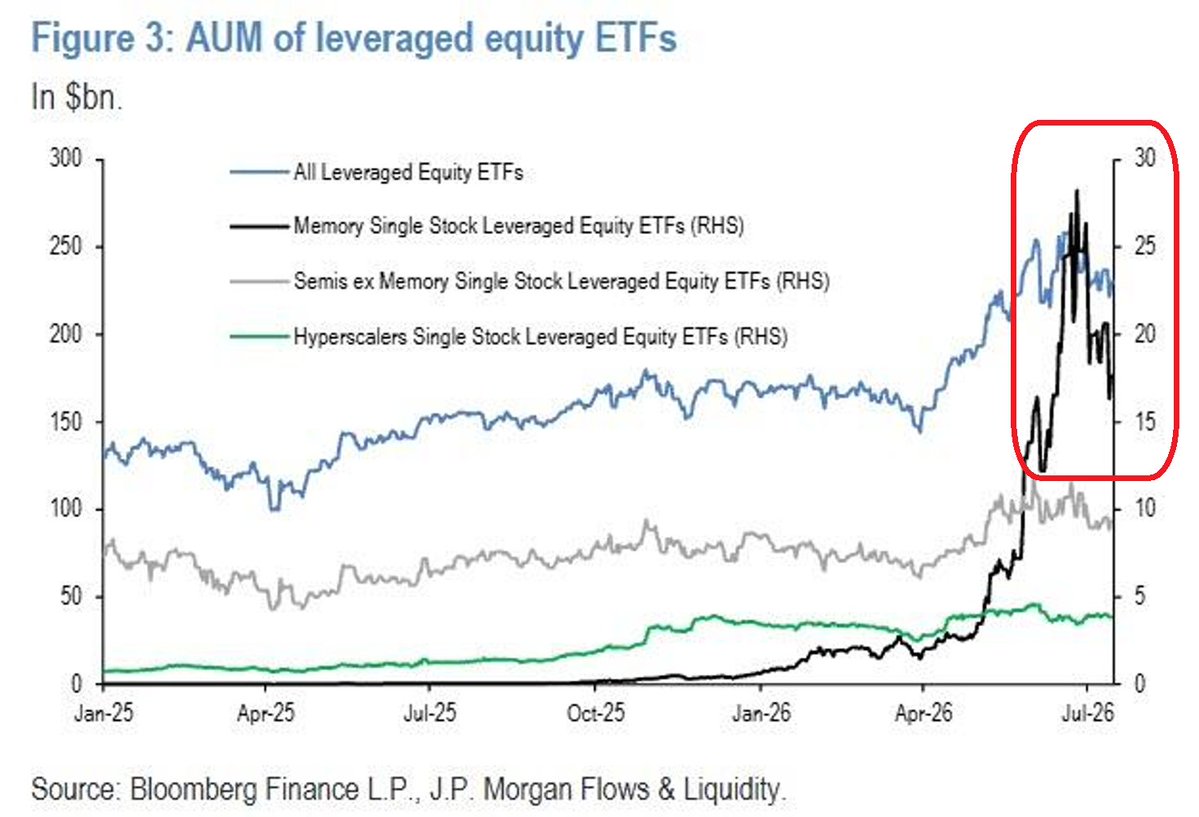 Memory single-stock leveraged ETFs lost $10B (-35%) since June peak — 3x the broader leveraged ETF decline
Layer 3: Why Are Stocks Falling When Fundamentals Are Fine?
A sell-side analyst provided the most accurate diagnosis:
"Micron announced memory LTAs with Qualcomm today, yet the stock dropped 5%+. This doesn't feel like something individually wrong with memory or AI names — all these structural agreements are still being signed. Feels more like the tail end of deleveraging and margin cascades."Three root causes:
1. CXMT's IPO threat — China's leading DRAM maker, ChangXin Memory Technologies (CXMT), is pushing for a massive IPO with plans to significantly expand DRAM production. Even though its technology lags by years, the market is already pricing in "future supply glut" risk.
2. Deleveraging and valuation reset — Massive inflows into memory leveraged ETFs over the past year created an extremely crowded trade. The decline triggered margin calls, causing a cascading liquidation spiral.
3. Sell the news — Positive catalysts like Micron's Qualcomm deal were simply ignored. TSMC just printed 68% gross margins. HBM is sold out through 2027. None of it mattered — the market sold first, asked questions later.
But Morgan Stanley just dropped a bombshell bull case:
Morgan Stanley projects Micron will generate approximately $400 billion in combined non-GAAP operating income across 2026 and 2027 — nearly 40% of its current market cap. They model gross margins at 85% to 89.5% — numbers that are literally unprecedented in memory chips.
The single driver behind all of this: AI's structural demand for HBM (High Bandwidth Memory).
What This Means for Investors
The semiconductor panic is sending a signal — but it may not be the one you think.
Short-term:- The selloff is primarily a trading structure issue (deleveraging, liquidations), not fundamental deterioration
- The China supply threat is real, but the technology gap remains significant
- The core AI demand narrative (HBM, advanced nodes) hasn't changed
- This correction could be one of 2026's best semiconductor buying opportunities
- But you need to survive the deleveraging process first — don't try to catch a falling knife
- Analysts broadly agree DRAM/NAND constraints will persist through 2027
Memory has always been cyclical. This time, AI-driven structural demand is something that never existed before. The cycle may still exist, but it now rides on top of a much higher base.
Those selling the picks and shovels always win — and semiconductors are the picks and shovels of the AI age.
FAQ
Q1: Is this the right time to buy into SOX?A1: Historically, when SOX hits -20%, the final bottom tends to be 10-20% lower. For long-term investors, dollar-cost averaging makes sense. For bottom fishers, patience is key.
Q2: Is Micron's business actually deteriorating?A2: No. Micron signed LTAs with Qualcomm, HBM capacity is sold out, and Morgan Stanley projects $400B in operating income. The selloff is predominantly a trading structure issue.
Q3: Has AI fundamentally changed the memory cycle?A3: Partially. AI's HBM demand is structural, not cyclical. But traditional DRAM/NAND still follow supply/demand cycles. What's different this time: AI demand absorbs so much capacity that it compresses the traditional cycle's amplitude.
Q4: Is CXMT a real threat?A4: On technology, CXMT's HBM lags by years. On capacity, yes — their expansion plans affect market sentiment. US export controls remain a significant barrier.
Q5: Is NVIDIA being dragged into this?A5: Yes, NVDA dropped ~1-2%. But NVIDIA's moat is in AI training chips — memory price fluctuations have minimal impact on its thesis. The bigger risk would be an AI CapEx slowdown, but there's no evidence of that yet.
Tags: #PhiladelphiaSemiconductor #SOX #Micron #MemoryChips #AISemiconductor #BearMarket #HBM #Deleveraging
留言
張貼留言