Black Monday in Seoul: KOSPI Crashes 8.95%, Breaks Below 7,000, Triggers 7th Circuit Breaker of 2026
One-line conclusion: On July 13, 2026, South Korea's KOSPI index plunged 8.95% to close at 6,807 points, triggering its 7th circuit breaker of the year as Middle East tensions, foreign capital flight, and retail margin call cascades converged into a perfect storm.
Introduction: Black Monday Descends on Seoul
July 13, 2026 will go down as one of the darkest trading days in South Korean financial history.
The KOSPI opened lower and never recovered. At 10:34 AM, a sell-side sidecar was triggered, halting program sell orders for five minutes. Then at 1:28 PM, with the index down over 8% for more than a minute, the Korea Exchange activated the circuit breaker, suspending all trading for 20 minutes.
When the dust settled, KOSPI closed at 6,806.93 — an 8.95% single-day collapse. It was the first time in over two months that the benchmark had fallen below the psychologically critical 7,000 level.
The Three Engines of Today's Meltdown
Unlike the July 7 selloff (KOSPI -8.18%, closed at 7,392 driven mainly by AI valuation concerns), today's crash was fueled by three simultaneous forces:
Engine 1: Escalating Middle East TensionsGeopolitical risk surged over the weekend as Iran-US tensions deteriorated sharply. South Korea, heavily dependent on Middle Eastern crude oil imports and semiconductor exports, is acutely vulnerable to regional instability.
Engine 2: Full-Scale Foreign ExitOn Friday (July 12), foreign investors had already dumped an estimated 1.8 trillion won ($1.3 billion) of Korean equities in a single morning session, triggering level-1 circuit breakers on both KOSPI and KOSDAQ simultaneously. Today, the selling intensified.
Engine 3: Margin Call Death SpiralThis uniquely Korean problem amplified everything. After a year of retail investors borrowing heavily to buy stocks (known locally as "debt investing" or 빚투), margin loan balances hit record highs. When the market turned, brokerages issued mass margin calls, forcing retail investors to liquidate positions, which pushed prices lower, triggering more margin calls — a self-reinforcing cycle of destruction.
 KOSPI's 2026 trajectory, breaking below 7,000 on July 13 with the 7th circuit breaker of the year. (Source: BullTheoryio / Twitter)
Heavyweights in Freefall
The two semiconductor giants that dominate KOSPI took the worst hits:
- SK Hynix: Crashed 15.37% to close at 1.845 million won, retreating approximately 38% from its June 25 all-time high
- Samsung Electronics: Fell approximately 7.72%, dropping into the 260,000 won range
Together, these two stocks account for more than half of the KOSPI index weighting. When they fall simultaneously, the index has no defense.
Seven Circuit Breakers in One Year — What Is Wrong With Korean Markets?
2026 has already seen 7 circuit breaker triggers on KOSPI — an extraordinary number by any standard.
The year started spectacularly: KOSPI surged as much as 122% from January to June, driven by the AI chip frenzy, making it one of the best-performing major stock markets globally. But since late June, the index has reversed violently, losing approximately 27% in just 25 days.
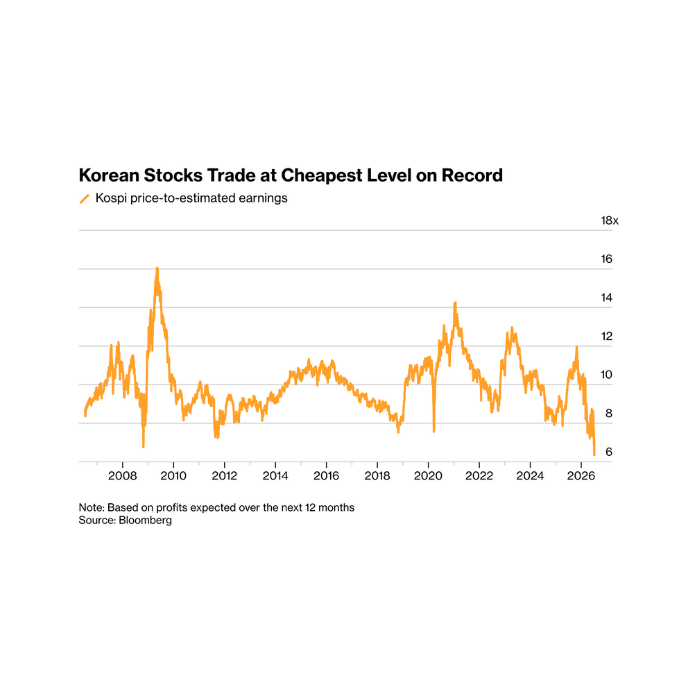
KOSPI now trades at a forward P/E of just 6.4 times earnings — below the level it reached during the 2008 financial crisis. But this "cheapness" is deceptive. The low multiple reflects the market's deep skepticism that semiconductor earnings can be sustained. Memory chips have always been a boom-and-bust business, and analysts expect earnings downgrades ahead.
The Brutal Reality of Leverage
Korean retail investors piled into margin trading during the bull run. As of early June:
- Samsung Electronics margin balance: 425.5 billion won
- SK Hynix margin balance: 353.0 billion won
- Some semiconductor ETFs had 70% of their capital funded by margin loans
The KORU (Direxion Daily South Korea Bull 3X ETF) gained over 500% during the first half of 2026. Today alone, it likely lost close to 27%. Leverage doesn't just magnify gains — it forces you to sell at the worst possible moment.
 KOSPI's P/E has fallen below 2008 crisis levels, but structural fragility is at an all-time high. (Source: BullTheoryio / Twitter)
Why Is Korea So Fragile?
Today's crash exposed deep structural vulnerabilities:
1. Extreme concentration: Samsung and SK Hynix alone drive roughly 70% of all trading volume in Korea when including their related ETFs and derivatives. 2. Retail mania: South Korea has one of the highest retail participation rates in the developed world, and retail investors overwhelmingly use margin trading — creating systemic risk. 3. Geopolitical exposure: Korea is heavily dependent on Middle Eastern oil and is a major semiconductor exporter. Iran-US tensions hit harder here than in other Asian markets. 4. Hot money dynamics: Foreign capital can exit Korean markets with extraordinary speed when sentiment turns. Friday and today's combined outflow was one of the largest in recent memory. Record inflows into US tech funds just before the crash. Extreme sentiment meets fragile market structure. (Source: Kobeissi Letter / Twitter)
Lessons for Every Investor
Korea's Black Monday is more than a local market event — it's a masterclass in risk management:
1. Leverage is a double-edged sword — it amplifies everything, including the moments when you're forced to sell at the worst possible time
2. Concentrated markets are fragile — when a handful of stocks determine your entire market's fate, any tremor becomes an earthquake
3. Geopolitical risk is unavoidable — markets exposed to regional instability will always be vulnerable to sudden shocks
4. Margin debt is a warning signal — when everyone is borrowing to buy stocks, caution is warranted
Frequently Asked Questions (FAQ)
How much did KOSPI fall on July 13, 2026?
KOSPI closed at 6,806.93, down 8.95% — its worst single-day drop in recent memory. It was the first time in two months the index closed below 7,000.
Did the circuit breaker trigger?
Yes. At 1:28 PM KST, the Korea Exchange issued a circuit breaker, halting all trading for 20 minutes. It was the 7th circuit breaker on KOSPI in 2026.
Why did Korea crash so hard today?
Three compounding factors: (1) Escalating Iran-US tensions; (2) Massive foreign capital exodus (1.8 trillion won on Friday alone); (3) Margin call cascades as retail leverage unwound violently.
How much did SK Hynix fall?
SK Hynix crashed 15.37%, retreating approximately 38% from its June 25 all-time high.
How is this different from the July 7 crash?
The July 7 crash (-8.18%, closed 7,392) was driven by AI stock valuation concerns. Today's crash (-8.95%, closed 6,807) was driven by Middle East geopolitics + foreign flight + margin liquidation, with a catalyst from outside the AI trade.
Has KOSPI entered a bear market?
Yes. From its 2026 peak, KOSPI has now declined more than 27%, well exceeding the 20% technical bear market threshold.
How many circuit breakers has KOSPI triggered this year?
Seven — an unprecedented number for a single year.
How serious is Korea's margin debt problem?
Samsung Electronics had 425 billion won in margin loans, SK Hynix had 353 billion won, and some semiconductor ETFs had 70% of their capital funded by margin. When the market drops, forced selling creates a cascading effect.
Tags: #SouthKorea #KOSPI #BlackMonday #CircuitBreaker #MiddleEast #ForeignSelling #MarginCall #SamsungElectronics #SKHynix #Semiconductors
留言
張貼留言